
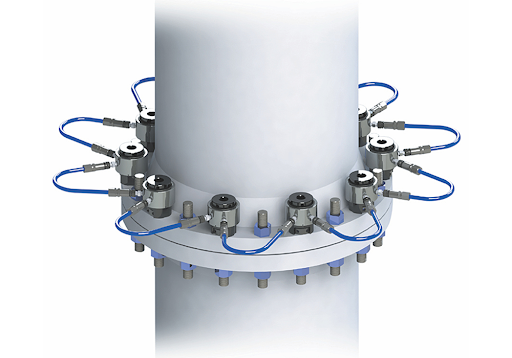
Flange leaking is one of the most frequent and expensive issues encountered in industrial pipe systems, leading to product loss, potential safety risks, environmental problems, and unplanned maintenance activities. However, in many cases, the main source of leakage does not relate to any fault in the gasket or flanges, but rather improper tightening of bolts.
Bolts’ pre-tensioning allows the creation of a specified level of clamping force for the gasket. Regardless of whether it was done using hydraulic tightening tools or stud tensioners, it is important to keep a proper and uniform preload in order to create a safe and leak-proof connection between flanges.
Why Do Flanges Leak?
The performance of a flange joint depends upon the effectiveness of its flange, gasket, and fastening system.
The possible reasons for leakage due to improper installation could be as follows:
- Uneven loadings of bolts
- Over-tightening and under-tightening of bolts
- Improper sequence in tightening bolts
- Poorly lubed bolts
- Deteriorated gaskets
- Fastener tightening errors
If bolts on a flange are tight at uneven loads, there will be uneven compression of the gasket, leading to poor seals and eventual leakage.
The Importance of Proper Bolt Load Control
Correct fastener tightening management includes ensuring that sufficient preload is applied to a fastener in order to create the necessary clamping force between a flanged joint. It can be done using either torque or bolt tensioning techniques.
The advantages associated with proper bolt preload control are many, some of which include:
- Even compression of the gasket
- Leakage prevention in flanges
- Overstressing and breakage prevention of the bolt
- Joint reliability while in operation
- Increased life span of gaskets and bolts
According to research conducted and practical experience, proper bolt preload is considered one of the crucial aspects when it comes to obtaining a reliable and leak-proof flange connection.
Best Practices for Leak-Free Flange Connections
-
Follow the Correct Tightening Sequence
Always use a cross-pattern or star-pattern tightening sequence. In this way, load distribution will be more uniform and less gasket distortion is achieved.
-
Tighten in Multiple Stages
Rather than applying full torque in a single pass, tighten bolts progressively.
A typical approach includes:
- First pass: 30% of target torque
- Second pass: 60% of target torque
- Final pass: 100% of target torque
This staged method helps achieve uniform bolt loading and better sealing performance.
-
Verify Tightening Accuracy
Using calibrated equipment is essential. Even small deviations in torque or preload can result in significant variations in bolt preload. Regular calibration helps ensure accurate and repeatable tightening results.
-
Use Controlled Bolting Techniques
In critical flanges, a controlled tightening method is used to apply the right amount of load on each bolt. This ensures human error is avoided when assembling joints.
Choosing the Right Equipment
In terms of heavy-duty bolts and important flanged connections, choosing the right bolting tools is imperative when it comes to precise and repeatable preloading.
A hydraulic torque wrench is commonly used for bolting and offers precise and repeatable accuracy. Stud tensioner bolting systems offer precise preload without using only torque, as they stretch the fastener, offering uniformity of force through the fastener.
With maintenance downtime activities and industrial assemblies, a bolt tightening machine will help increase productivity while providing consistency in bolting activity.
Conclusion
The flange leakage can be greatly minimized by applying the right amount of bolt load during assembly. Industries should be able to enhance their flange integrity and prevent unplanned downtime through proper torque control involving the application of the appropriate tightening pattern, proper calibration of equipment, and controlled bolting techniques.
Industries will be able to attain precise and uniform bolt preload through the utilization of stud tensioners, bolt tightening machines, and bolting service by controlling the bolt loading process.
