
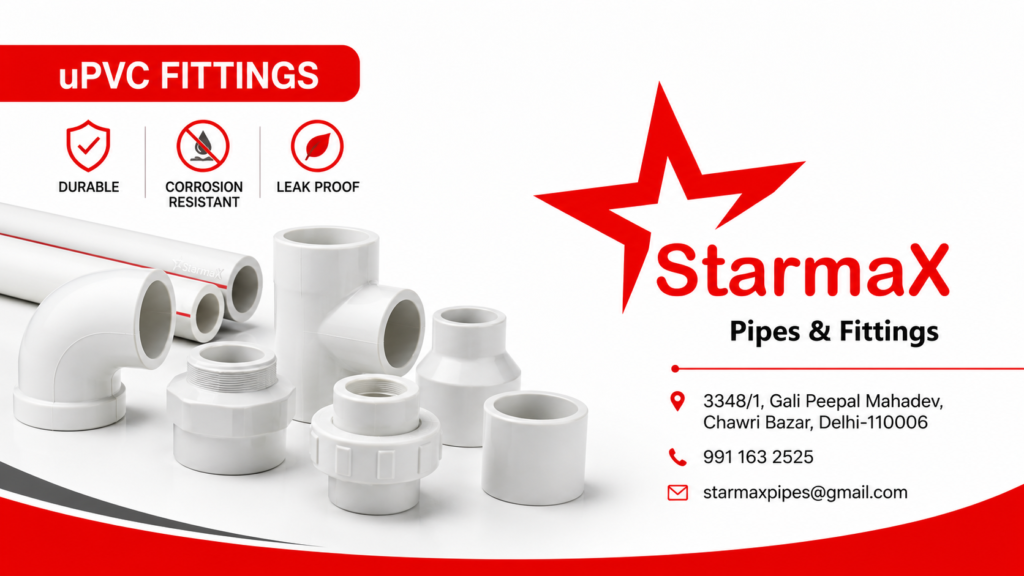
Every plumbing project, big or small, hinges on one critical decision — the choice of fittings. Get it wrong, and you are looking at leaks, corrosion, costly repairs, and a system that struggles long before it should. Get it right, and the plumbing practically runs itself for decades.
That shift in thinking is why builders, contractors, and homeowners across India have increasingly moved toward UPVC fittings over traditional metal or standard PVC alternatives. Not because of trends, but because the performance data and on-ground results speak clearly. Starmax, a brand rooted in engineering discipline and quality manufacturing, has been at the centre of this shift — supplying fittings that hold up under real-world pressure, across a wide range of applications.
If you are evaluating your options for a new build, renovation, or infrastructure upgrade, here is a clear-eyed look at what makes UPVC pipe fittings the smarter structural choice for modern plumbing systems.
1. Corrosion Resistance That Actually Lasts
Metal fittings rust. That is not a flaw — it is simply the nature of the material. Over time, exposure to water, soil moisture, and varying pH levels causes iron and even galvanised steel fittings to degrade from the inside out. The result is reduced water quality, weakened joints, and eventual failure.
UPVC fittings carry none of that risk. Unplasticised PVC is chemically inert, which means it does not react to water, most acids, or the mineral content found in typical supply lines. There is no oxidation, no scaling from mineral deposits, and no internal pitting. For drinking water supply lines or systems carrying treated water, this matters enormously.
Starmax formulates its fittings using lead-free compounds, which is especially significant for potable water applications where material safety is non-negotiable. The absence of lead and rust-causing metals keeps the water chemistry stable from source to tap.
2. Built to Handle Pressure Without Added Weight
One of the more practical advantages of UPVC plumbing fittings is their combination of structural strength and low weight. This is not a minor convenience — it has real implications for installation cost, labour time, and long-term structural load.
UPVC fittings are considerably lighter than their metal counterparts, making them easier to handle, transport, and install in confined spaces like ceiling cavities, wall chases, and underground trenches. On large-scale projects, the cumulative weight savings from fittings alone can meaningfully reduce both labour hours and structural support requirements.
Despite being lightweight, properly manufactured UPVC fittings maintain strong resistance to pressure and mechanical stress. Starmax products undergo rigorous testing to ensure they meet consistent performance benchmarks — so the savings in weight do not translate to compromises in structural integrity.
How UPVC Fittings Perform in Extreme Conditions
Plumbing systems do not operate in controlled laboratory environments. They face seasonal temperature shifts, chemical exposure from cleaning agents and soil, UV radiation in exposed outdoor runs, and continuous hydraulic pressure over years of use. The material you choose has to hold up across all of these variables — not just one or two.
UPVC fittings, particularly those manufactured under strict quality controls, are UV-stabilised to resist degradation from sun exposure. This makes them viable for above-ground and partially exposed installations without requiring additional protective coatings. The material also maintains its dimensional stability across a reasonable range of temperatures, which prevents the expansion-and-contraction stress that causes joint failures over time.
Starmax produces its fittings with weather-resistant formulations, making them appropriate for both interior and exterior applications across diverse climate conditions. This flexibility reduces the need for material-specific systems and simplifies procurement for multi-environment projects.
3. Leak-Free Joints Through Solvent Welding
Joint integrity is the most common point of failure in plumbing systems. Threaded metal joints rely on sealants and torque; rubber gaskets compress and age; push-fit connectors depend on O-ring precision. Each of these introduces a variable that can, and often does, become a maintenance issue.
UPVC pipe fittings use solvent cement welding, which chemically fuses the fitting and pipe into a single continuous unit. There is no separate seal, no mechanical fastener, and no compression ring to replace. The joint itself becomes part of the pipe — uniform in material, pressure-rated to the same standard, and resistant to the same range of chemicals.
This method of joining is why UPVC plumbing systems consistently outperform threaded or gasket-based systems in long-term leak performance. Properly installed solvent-welded joints require minimal maintenance and remain structurally sound for decades under normal operating conditions.
4. Cost Efficiency Over the Full Project Lifecycle
Upfront material cost is only one part of what a plumbing system actually costs. Installation labour, maintenance frequency, component replacement, and downtime all factor into the real total. Evaluated across those parameters, UPVC fittings consistently deliver strong value compared to metal alternatives.
Lower material cost, faster installation due to lightweight handling and solvent welding, and near-zero maintenance requirements over the system’s life add up to significant savings on total project cost. For developers managing multiple units or contractors working across large commercial builds, these savings are compounded at scale.
Starmax offers transparent pricing across its full range of fittings — from standard couplers and elbows to threaded adapters and step-over bends — which makes project budgeting more accurate and procurement straightforward without hidden cost variables.
5. Versatility Across Residential and Commercial Applications
A fitting system that works well in one application but poorly in another forces compromises at the design stage. UPVC fittings do not create that problem. The same material chemistry that makes them suitable for residential potable water supply also qualifies them for drainage systems, agricultural irrigation networks, rainwater management, and industrial process lines.
This application flexibility means architects, specifiers, and contractors can standardise on a single fitting system across different project types — simplifying inventory management, reducing training requirements, and streamlining quality control across sites.
Starmax’s range spans over 300 products, covering the full complement of joints, bends, tees, unions, and transitions that a modern plumbing specification might require. Whether the project is a residential housing scheme or a large commercial development, the product depth is there to support it without switching between suppliers or systems.
Frequently Asked Questions
Q1. What makes UPVC fittings different from standard PVC fittings?
UPVC (Unplasticised Polyvinyl Chloride) is manufactured without the plasticiser additives found in standard PVC. This makes it harder, more rigid, and significantly more resistant to chemical attack and pressure. Standard PVC can soften over time, particularly under heat and UV exposure, whereas UPVC maintains its structural properties across a wider range of conditions.
Q2. Are UPVC fittings safe for drinking water supply lines?
Yes. Lead-free UPVC fittings are approved for potable water applications. Because the material is chemically inert and does not leach metals or plasticiser compounds into the water supply, it is considered a hygienic and safe option for residential and commercial drinking water systems.
Q3. How long do UPVC pipe fittings typically last in a plumbing system?
Under normal operating conditions, well-manufactured UPVC fittings can perform reliably for 25 to 50 years. The actual service life depends on installation quality, operating pressure, and exposure conditions — but the material’s resistance to corrosion, scaling, and chemical degradation means it is not subject to the gradual deterioration that limits metal fittings.
Q4. Can UPVC fittings be used for both above-ground and underground plumbing?
Yes. UV-stabilised UPVC fittings are suitable for above-ground applications where sun exposure is a factor. For underground use, the chemical resistance of the material protects against soil acids and groundwater. Proper bedding and backfill practices should still be followed to avoid mechanical stress on the joints.
Q5. What should I check before purchasing UPVC fittings for a large project?
Verify that the fittings are manufactured to recognised quality standards, are lead-free, and have been tested for the specific pressure class your application requires. Confirm the supplier offers the full range of components your specification calls for — elbows, tees, reducers, unions, and adapters — so you are not mixing systems from multiple sources, which can create compatibility issues at joints.
Conclusion
Plumbing infrastructure is one of those areas where the right material decision pays dividends for the entire life of a building — and the wrong one becomes a persistent, expensive problem. UPVC fittings offer a combination of corrosion resistance, joint reliability, material safety, application flexibility, and lifecycle cost efficiency that is difficult to match with conventional alternatives.
Starmax approaches this product category with the same discipline it brings to its broader range — consistent manufacturing quality, transparent pricing, and a product depth that supports real-world project requirements. For professionals and property owners who want a plumbing system built to last, understanding what UPVC fittings actually deliver — beyond the marketing — is the starting point for making a sound decision.
