
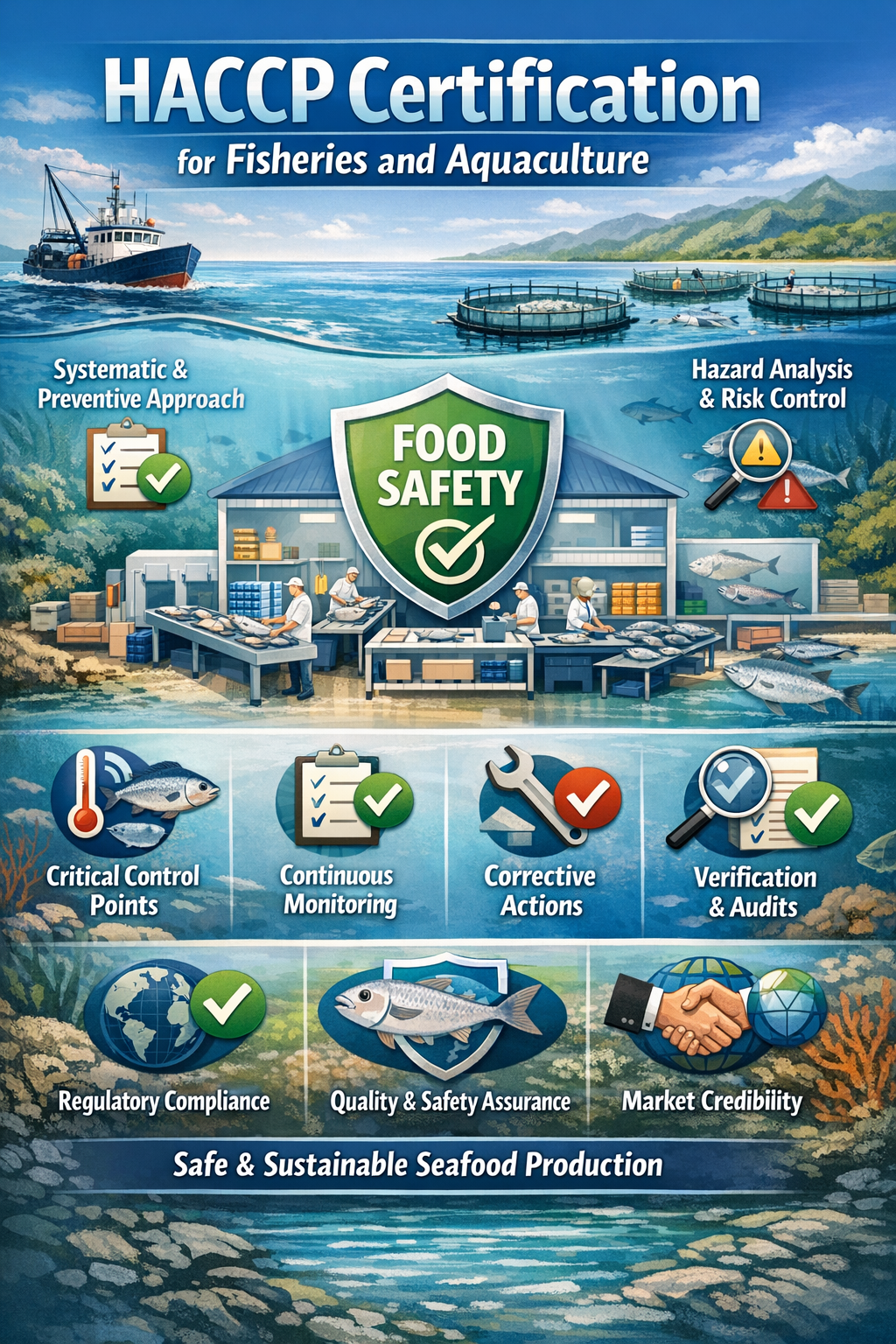
Introduction to HACCP Certification in Fisheries and Aquaculture
HACCP certification is a structured system designed to ensure food safety through a preventive approach. In fisheries and aquaculture businesses, biological variability and environmental exposure are unavoidable. Therefore, HACCP certification provides a disciplined method to identify, evaluate, and control hazards.
Instead of relying on final product inspection, it integrates safety controls directly into operational processes. As a result, risks are managed systematically from harvesting to final distribution.
Scope and Relevance of HACCP Certification
HACCP certification applies to a wide range of operations, including capture fisheries, fish farms, hatcheries, processing units, and cold storage facilities. Due to the highly perishable nature of seafood, the risk of contamination is significant.
Therefore, HACCP certification offers a consistent framework to maintain safety standards. In addition, it helps businesses manage operational complexity, environmental variability, and supply chain dependencies effectively.
Hazard Identification in Seafood Operations
A key element of HACCP certification is hazard identification. These hazards are generally classified into biological, chemical, and physical categories.
For example, biological hazards include harmful microorganisms, while chemical hazards may arise from toxins or residues. Physical hazards, on the other hand, involve foreign objects.
Thus, HACCP certification requires a systematic evaluation of risks at every stage. This ensures that all potential sources of contamination are clearly identified and documented.
Critical Control Points in Fisheries and Aquaculture
HACCP certification focuses on identifying critical control points (CCPs). These are stages where control measures can prevent or eliminate hazards.
In fisheries and aquaculture, CCPs often include harvesting methods, temperature control, water quality, and processing conditions. By identifying these points, businesses can focus on high-risk areas. Consequently, risk management becomes more efficient and effective.
Establishing Critical Limits and Monitoring Systems
Each CCP must have clearly defined critical limits. These limits separate safe conditions from unsafe ones and may include temperature, time, or pH levels.
Moreover, monitoring systems are established to ensure these limits are consistently maintained. HACCP certification requires regular monitoring, accurate record-keeping, and periodic reviews. This helps maintain operational control at all times.
Corrective Actions and Deviation Management
Whenever a deviation occurs, HACCP certification requires predefined corrective actions. These actions aim to restore control and prevent unsafe products from reaching the market.
For instance, businesses may adjust storage conditions, isolate affected products, or revise procedures. In this way, risks are addressed quickly and effectively.
Verification and Validation Processes
Validation ensures that control measures effectively manage hazards. Meanwhile, verification confirms that the HACCP system is functioning properly.
These activities include internal audits, equipment calibration, and record reviews. Therefore, ongoing verification is essential to maintain system reliability, especially under changing conditions.
Documentation and Record Control
Documentation plays a central role in HACCP certification. It provides evidence of system implementation and effectiveness.
Important records include hazard analyses, CCP details, monitoring logs, corrective actions, and verification reports. Proper documentation improves traceability and supports audits. Additionally, it enhances transparency and decision-making.
Implementation in Fisheries
Implementing HACCP in fisheries involves evaluating all stages, from catch handling to distribution. This includes forming a HACCP team, describing processes, and conducting hazard analysis.
Special attention is given to onboard handling, icing methods, and transportation. As a result, product safety and quality are consistently maintained.
Implementation in Aquaculture
In aquaculture, HACCP focuses on risks linked to controlled aquatic environments. Key factors include water quality, feed safety, disease control, and harvesting practices.
Continuous monitoring is essential to maintain safe conditions. Consequently, businesses can achieve consistent production despite environmental and biological challenges.
Role of Personnel and Training
HACCP certification depends heavily on trained personnel. Employees must understand their responsibilities, including monitoring and corrective actions.
Therefore, regular training programs are essential. In environments with high manual handling, human awareness plays a critical role in maintaining food safety.
Internal Audits and Continuous Improvement
Internal audits help evaluate the effectiveness of the HACCP system. They assess compliance, control measures, and documentation accuracy.
Furthermore, HACCP promotes continuous improvement. Audit findings are used to refine processes and strengthen system performance over time.
Certification and External Assessment
HACCP certification is granted after an external audit by an accredited body. This assessment reviews system design, implementation, and effectiveness.
Successful certification demonstrates compliance with recognized food safety standards. As a result, businesses gain credibility and improved market acceptance.
Benefits of HACCP Certification
HACCP certification offers several advantages. It improves food safety, reduces contamination risks, and enhances operational efficiency.
In addition, it supports regulatory compliance and opens access to global markets. Ultimately, it strengthens customer trust and builds a strong reputation for quality.
Conclusion
HACCP certification provides a structured approach to food safety in fisheries and aquaculture. By focusing on prevention, control, and monitoring, it ensures effective risk management.
Moreover, it supports consistency, compliance, and market credibility. Therefore, HACCP certification remains essential for sustainable and reliable seafood production.
