
Introduction
You’ve invested in a quality embroidery machine, you’ve sourced perfect blanks, and you have a stunning design ready to go. Yet, when you hit start, the dream of smooth, professional embroidery quickly unravels. Thread breaks, fabric puckers, and your design looks nothing like the crisp image on your screen. The frustration is real, and it’s familiar to anyone who’s tried to shortcut the most critical step in the process: digitizing. This is where a professional Digitizer Embroidery Service becomes your secret weapon. It’s the master key that unlocks consistent, smooth stitching, transforming your projects from a battle with your machine into a reliable, satisfying craft. This guide will show you exactly how a professional service turns digital chaos into thread-perfect order.
The Root of the Problem: Why Your Files Fight Back
To understand the solution, you must first diagnose the problem. Most stitching issues aren’t mechanical failures; they’re digital.
- Thread Breaks & Needle Breaks: Often caused by excessive stitch density. The needle is trying to punch through a brick of thread instead of fabric.
- Puckering & Fabric Distortion: The silent scream of a file with no underlay. The top stitches pull directly on unstable fabric, causing it to gather and wrinkle.
- Misaligned Designs & “Off-Registration”: Illogical stitch sequencing or lack of proper pull compensation means elements don’t line up, leaving you with a messy final product.
- Stiff, Cardboard-like Feel: A design digitized for screen appearance, not wearability. Overly dense stitching creates a patch that’s uncomfortable and can damage delicate fabrics.
- Lost Details & Blurry Text: Tiny elements or fine fonts are digitized as dense fills instead of clean satin or run stitches, turning them into unreadable blobs.
These are not machine errors. They are the direct result of a poor-quality digital file. Using auto-digitized files or amateur conversions is like building a house on sand; the foundation can’t support the structure.
The Professional Difference: Engineering, Not Just Converting
A professional Digitizer Embroidery Service does not run your image through an automated filter. They employ skilled digitizers who act as both translators and engineers. Here’s what you’re actually investing in:
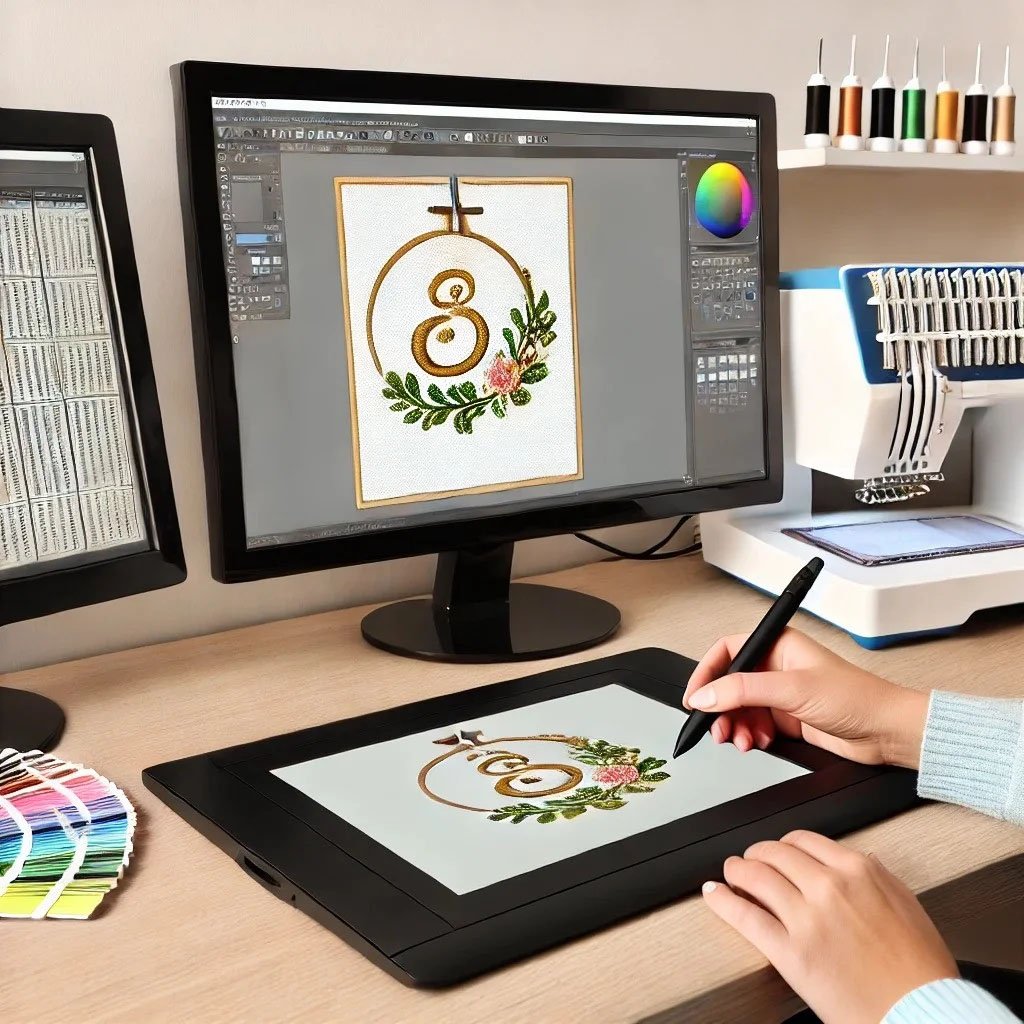
1. Manual, Artisanal Digitizing: Every stitch is intentionally placed using professional software like Wilcom or Pulse. The digitizer manually traces your artwork, making conscious decisions about how to best represent each element in thread.
2. The Invisible Foundation: Strategic Underlay: This is the hallmark of a pro. Before a single decorative stitch is placed, the digitizer builds a hidden framework. This underlay stabilizes the fabric, prevents puckering, and creates a perfect, raised base for the top stitches to sit on. It’s the difference between a design that lies flat and one that ripples the fabric.
3. Physics in Practice: Pull Compensation: Thread naturally pulls on fabric as it sews. A professional proactively adjusts shapes in the digital file—slightly widening the inside of curves, extending points—so they sew out perfectly. Circles stay round, and corners stay sharp.
4. Intelligent Stitch Pathing: The digitizer maps the most efficient route for the needle. They group colors logically and minimize long “jump stitches” and trims. This creates a cleaner back, reduces machine runtime, and drastically cuts down on thread breaks.
5. Fabric-Specific Calibration: A pro will ask, “What are you stitching this on?” A file for a stretchy performance tee is engineered completely differently than one for a stiff canvas bag or a structured cap. Stitch density, underlay type, and tension are all calibrated for the target material.
The Service Workflow: Your Path to Guaranteed Smoothness
Working with a professional service is a collaborative and secure process designed for success.
Step 1: The Detailed Brief. You provide your high-quality artwork (vector files like .AI or .EPS are ideal) and crucially, you specify the garment type, fabric, and finished size. This brief is the engineering blueprint.
Step 2: Manual File Creation & Internal Testing. The digitizer manually creates your file using the techniques above. Then—and this is critical—they perform an internal test sew-out on fabric similar to your target material.
Step 3: Proof Delivery & Collaboration. You don’t just get a mystery file. Reputable services provide the final digital file along with clear photos or a video of the physical test stitch-out. This is your proof of performance. You can see the smooth, clean result before it ever touches your machine.
Step 4: Final Delivery & Peace of Mind. You receive a production-ready file (e.g., .DST, .PES, .EXP) that is guaranteed to run. You gain a partner who stands behind their work, often including minor adjustments to ensure perfection.
The Tangible Benefits: What “Smooth Stitching” Really Means for You
Unlocking smooth stitching translates into direct, measurable advantages:
- Eliminate Wasted Time & Materials: No more babysitting the machine, re-threading, or throwing away ruined garments. Your production becomes predictable and efficient.
- Professional, Brand-Enhancing Results: Every stitch-out is crisp, clean, and durable. Whether for client work or personal projects, the quality elevates your craft.
- Preserve Your Equipment: Smooth-running files reduce wear and tear on your machine, needles, and hoops, saving on long-term maintenance costs.
- Scale Your Confidence: You can take on larger orders or more complex designs knowing your digitizing won’t be the bottleneck or point of failure.
- Reclaim the Joy of the Craft: Instead of dreading the next thread break, you get to enjoy the mesmerizing process of watching a perfect design come to life, stitch by flawless stitch.
How to Identify a Truly Professional Service
Not all services are created equal. Look for these green flags:
- They Ask Specific Questions about fabric and use before giving a quote.
- Their Portfolio Features Photos of Actual Stitch-Outs on various materials, not just software simulations.
- They Explicitly Include a Test Sew-Out as part of their standard deliverable.
- They Communicate Clearly about timelines, revision policies, and file formats.
- They Have Experience with Commercial Formats and understand the needs of embroiderers, not just graphic designers.
The Cost vs. Value Equation: An Investment, Not an Expense
It’s easy to see a professional service fee and think of cheaper alternatives. But consider the true cost:
- The Cost of a Failed Stitch-Out: Ruined $30 jacket + wasted thread/stabilizer + 30 minutes of labor.
- The Cost of Inefficiency: An hour of machine downtime and operator frustration on a multi-piece order.
- The Cost of Reputation: Delivering a subpar product to a client.
A single professional digitizing fee (often $20-$50) protects you from all these hidden costs. It’s an investment in a flawless, reusable digital asset that ensures every subsequent stitch-out is smooth and profitable.
Conclusion: Stop Fighting, Start Stitching
Smooth stitching isn’t a lucky accident; it’s the inevitable result of a perfectly engineered file. By partnering with a professional Digitizer Embroidery Service, you move from being a technician constantly troubleshooting problems to an artist confidently executing your vision. You unlock the full potential of your machine and your creativity. The frustrating cycle of breaks, puckers, and disappointments ends, replaced by the reliable, satisfying rhythm of a needle creating exactly what you envisioned. Don’t let poor digitizing be the barrier between you and perfect embroidery. Invest in the expertise that builds the foundation for every great stitch, and experience the transformative power of truly smooth stitching.
