
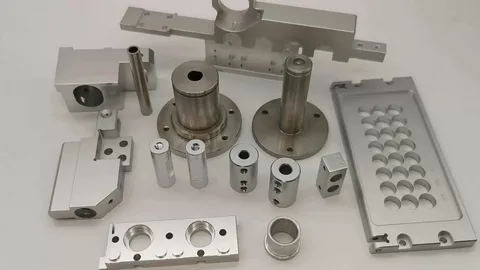
In modern manufacturing, precision and durability are essential for producing reliable industrial components. One of the most effective technologies supporting this demand is CNC machining, which allows manufacturers to create highly accurate and repeatable parts. Industries such as automotive, aerospace, medical, robotics, and heavy machinery rely heavily on custom CNC machined parts to maintain performance, safety, and efficiency.
As global competition increases, businesses are turning toward advanced machining solutions to meet strict quality standards and reduce production errors. Custom CNC machining provides flexibility, speed, and consistency that traditional manufacturing methods often cannot match. This article explores how high-quality CNC machined parts are transforming industrial applications and why they are essential for modern engineering.
The Importance of Custom CNC Machined Parts in Modern Industry
Custom CNC machining plays a vital role in producing components tailored to specific industrial requirements. Unlike standard parts, custom CNC machined parts are designed with precise dimensions, tolerances, and materials to meet unique operational needs. This ensures better compatibility, efficiency, and long-term reliability in complex systems.
Industries depend on these parts to reduce downtime and improve machine performance. From engine components to structural assemblies, CNC machining ensures every part meets exact specifications without compromise.
Key benefits include:
- High dimensional accuracy for complex designs
- Consistent quality across large production batches
- Reduced material waste during manufacturing
- Ability to create highly specialized components
- Improved product performance and lifespan
These advantages make CNC machining an essential part of industrial production systems worldwide.
Materials Used in High-Quality CNC Machining
The choice of material significantly affects the performance and durability of custom CNC machined parts. CNC machines can work with a wide range of materials, allowing manufacturers to select the best option based on strength, weight, corrosion resistance, and application requirements.
Common materials include metals like aluminum, stainless steel, brass, titanium, and even engineering plastics such as nylon and PEEK. Each material serves a specific purpose depending on environmental conditions and mechanical stress.
Popular CNC machining materials:
- Aluminum: Lightweight and corrosion-resistant
- Stainless Steel: High strength and durability
- Titanium: Excellent strength-to-weight ratio
- Brass: Good conductivity and machinability
- Engineering Plastics: Insulation and chemical resistance
Selecting the right material ensures that CNC machined parts perform reliably under demanding industrial conditions while maintaining cost efficiency.
Precision Engineering and Manufacturing Process
The manufacturing process of custom CNC machined parts involves computer-controlled tools that follow programmed instructions with extreme precision. This eliminates human error and ensures consistent accuracy across every unit produced.
The process begins with CAD (Computer-Aided Design) modeling, followed by CAM (Computer-Aided Manufacturing) programming. Once the design is finalized, CNC machines such as mills, lathes, or routers execute the production with micron-level precision.
Core steps in CNC machining:
- Creating a detailed CAD model
- Converting design into CNC-compatible code
- Selecting appropriate tooling and material
- Machine setup and calibration
- Precision cutting, drilling, and finishing
This highly controlled process ensures that even the most complex geometries can be manufactured efficiently and accurately, making CNC machining ideal for industrial applications.
Applications of Custom CNC Machined Parts in Industry
Custom CNC machined parts are used across a wide range of industries due to their adaptability and precision. From small mechanical components to large structural elements, CNC machining supports critical operations in various sectors.
Industries benefit from CNC parts because they improve efficiency, reduce failure rates, and support innovation in product design. These components are often used in environments where reliability is non-negotiable.
Major industrial applications include:
- Automotive: Engine parts, gears, and transmission components
- Aerospace: Aircraft structural and engine components
- Medical: Surgical instruments and implant devices
- Robotics: Precision joints and mechanical arms
- Industrial Machinery: Heavy-duty machine components
The versatility of CNC machining allows engineers to design highly specialized solutions that meet strict industry standards.
Advantages of Using Custom CNC Machined Parts in Manufacturing
Manufacturers prefer custom CNC machined parts because they offer unmatched precision and efficiency. These parts help reduce production time while ensuring consistent output quality, which is critical for large-scale industrial operations.
Additionally, CNC machining supports rapid prototyping, allowing companies to test and refine designs before mass production. This reduces risk and accelerates product development cycles.
Key advantages include:
- High repeatability for mass production
- Faster turnaround time compared to manual machining
- Reduced production errors and rework costs
- Enhanced design flexibility for complex parts
- Strong compatibility with automation systems
These benefits make CNC machining a cornerstone of modern industrial manufacturing strategies.
Conclusion
High-quality custom CNC machined parts have become essential in today’s industrial landscape due to their precision, reliability, and adaptability. From material selection to advanced machining processes, CNC technology ensures that every component meets strict performance standards.
As industries continue to evolve, the demand for accurate and durable components will only increase. CNC machining not only meets these expectations but also drives innovation by enabling more complex and efficient designs. Businesses that invest in high-quality CNC machined parts gain a competitive advantage through improved performance, reduced costs, and long-term operational success.
