
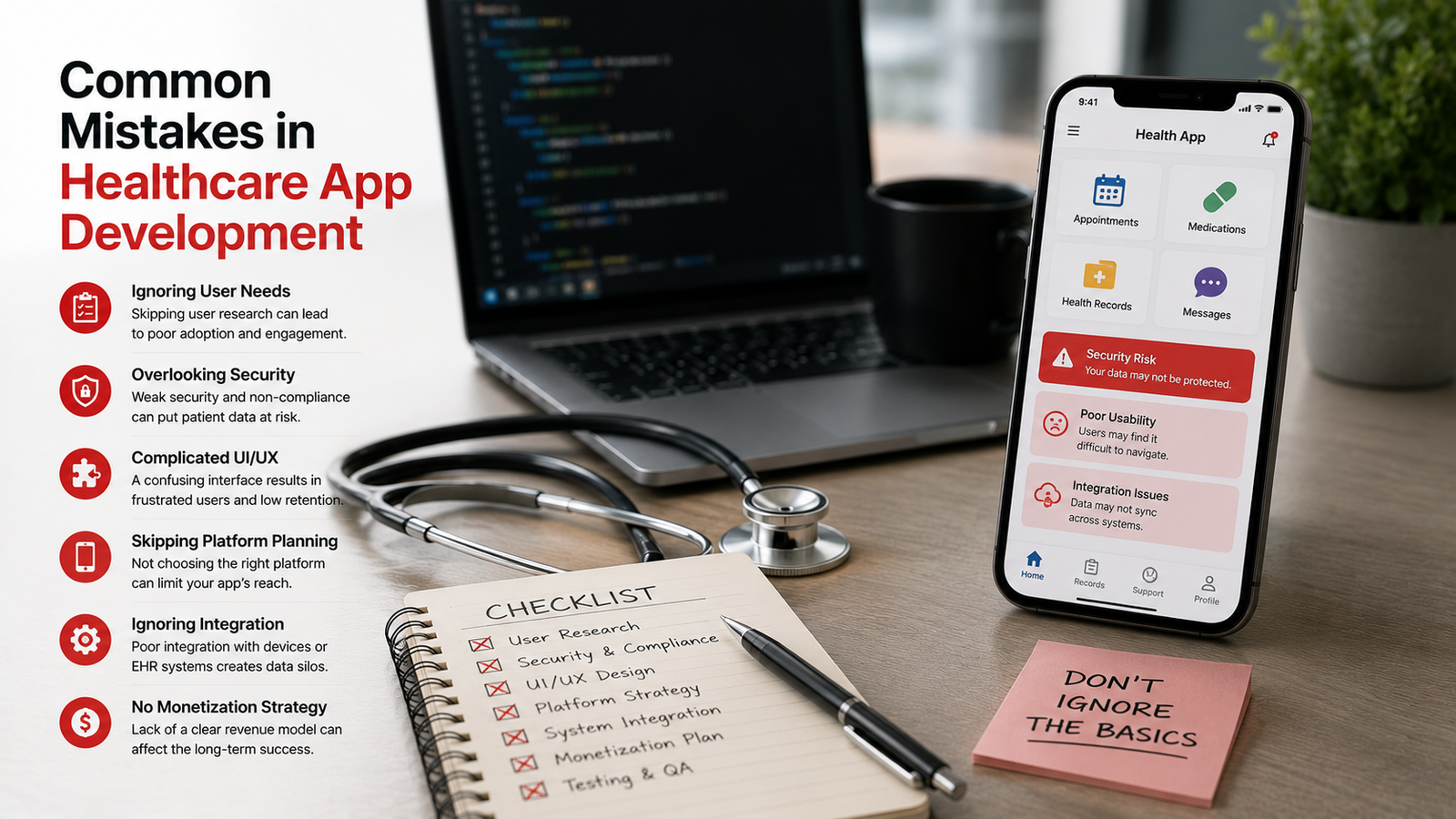
Most healthcare apps don’t fail because the idea was bad. They fail because somewhere between the whiteboard and the app store, the team made a handful of avoidable mistakes that quietly compounded until the whole thing collapsed under its own weight.
I’ve watched it happen up close more than once. A promising product, real funding, smart people and then it stalls, not from one dramatic disaster but from a slow pile-up of small wrong turns nobody caught early. The frustrating part is how predictable these missteps are. The same ones show up again and again, which means if you know what they look like, you can dodge most of them before they cost you anything. That’s true whether you’re building in-house or handing it to a healthcare app development company to execute.
So let’s walk through the ones that bite people hardest.
Treating compliance as a later problem
This is the big one. The expensive one. The one that ends companies.
Founders get excited about features and treat HIPAA, data security, and regulatory stuff as boring paperwork they’ll “deal with before launch.” Then launch gets close, someone finally reads the rules, and they realize compliance isn’t a coat of paint you brush on at the end it’s structural. It affects how you store data, how you authenticate users, which vendors you can even use, how every piece of protected health information (PHI) moves through the system.
Retrofitting that onto a finished app is a nightmare. Sometimes you’re rebuilding the backend from scratch. Build it in from line one instead. Get your Business Associate Agreements (BAAs) sorted with every vendor touching PHI, encrypt everything, bake in audit logs. Boring upfront, lifesaving later.
Building for patients and forgetting the clinicians
Here’s a sneaky one. Teams design this beautiful patient-facing experience and completely overlook the people on the other side the doctors, nurses, and staff who’ll actually have to use it dozens of times a day.
Clinicians are drowning. They’re already buried in clunky software and click fatigue, and if your app adds even thirty seconds of friction to their workflow, they’ll route around it or flat-out refuse to touch it. An app that patients love but providers hate is a dead app. Talk to the clinical side early, watch how they actually work, and fit into their day instead of demanding they reshape it around you.
Skipping real user testing
A lot of teams test their app the way the developers expect it to be used by people who built it and already know exactly where everything is. That’s not testing. That’s a demo.
Real patients include elderly folks, people with disabilities, people in a panic because something’s wrong with their health, people who aren’t fluent in tech or even in your app’s language. If your onboarding confuses a stressed 70-year-old, that’s not their failure, it’s yours. Accessibility isn’t a nice-to-have in healthcare either larger text, screen-reader support, high contrast, simple flows. Watch real users from your actual target groups stumble through it, then fix what trips them. Every time, without fail, you’ll discover something you’d have sworn was obvious.
Underestimating integration especially with EHRs
Here’s where a lot of timelines and budgets quietly explode.
A healthcare app that lives on its own little island, disconnected from everything, usually isn’t all that useful. The value tends to come from connecting to electronic health records, labs, pharmacies, wearables. And those connections are hard. Standards like HL7 and FHIR exist to move health data between systems, but actually implementing them, passing a hospital IT department’s security review, handling messy real-world data formats that’s serious engineering. Teams routinely assume “we’ll just plug into their EHR” and then lose months to it. Interoperability is a project, not a checkbox. Plan for it.
Scope creep and the everything-app trap
Ambition is great until it quietly kills you. Teams try to launch with every feature imaginable appointments, messaging, records, billing, a symptom checker, a pharmacy, the works and they end up with a bloated, half-finished mess that took twice as long and does nothing especially well.
Pick the one thing your app does better than anyone, nail it, ship it. An MVP that solves a single real problem beautifully beats a sprawling platform that solves ten things badly. You can always add later, once people are actually using the thing and telling you what they want next.
A few more that quietly sink products
Not every mistake needs its own sermon. Some shorter ones worth burning into memory among the Mistakes to Avoid in Healthcare App Development
Ignoring scalability building something that works fine for 200 users and chokes at 20,000, then scrambling to re-architect under pressure. Skimping on security to ship faster, in the one industry where a breach can literally end you. Picking a generic dev team with zero healthcare experience to save a little money, then paying triple to fix what they didn’t know they were getting wrong. Launching with no plan for ongoing maintenance, so the app slowly rots as operating systems update and bugs pile up. And forgetting that real people in vulnerable moments are on the other side of the screen designing coldly, for a spec sheet instead of a scared human.
None of those are exotic. They’re just easy to wave off when you’re moving fast and trying to hit a deadline.
The pattern underneath all of them
Squint at this whole list and you’ll notice they share a root. Almost every one comes from rushing skipping the unglamorous, careful, slow work in favor of speed, and assuming the hard parts will sort themselves out later. In most software, that gamble sometimes pays off. In healthcare, where the stakes are people’s wellbeing and the rules have teeth, it almost never does.
The teams that succeed here aren’t smarter than the ones that don’t. They’re just more willing to do the boring parts properly compliance early, clinicians in the room, real users tested, integrations respected, scope held tight. Do that, and you skip past the graveyard most healthcare apps end up in. Not because you got lucky. Because you refused to make the mistakes everyone else keeps making.
