
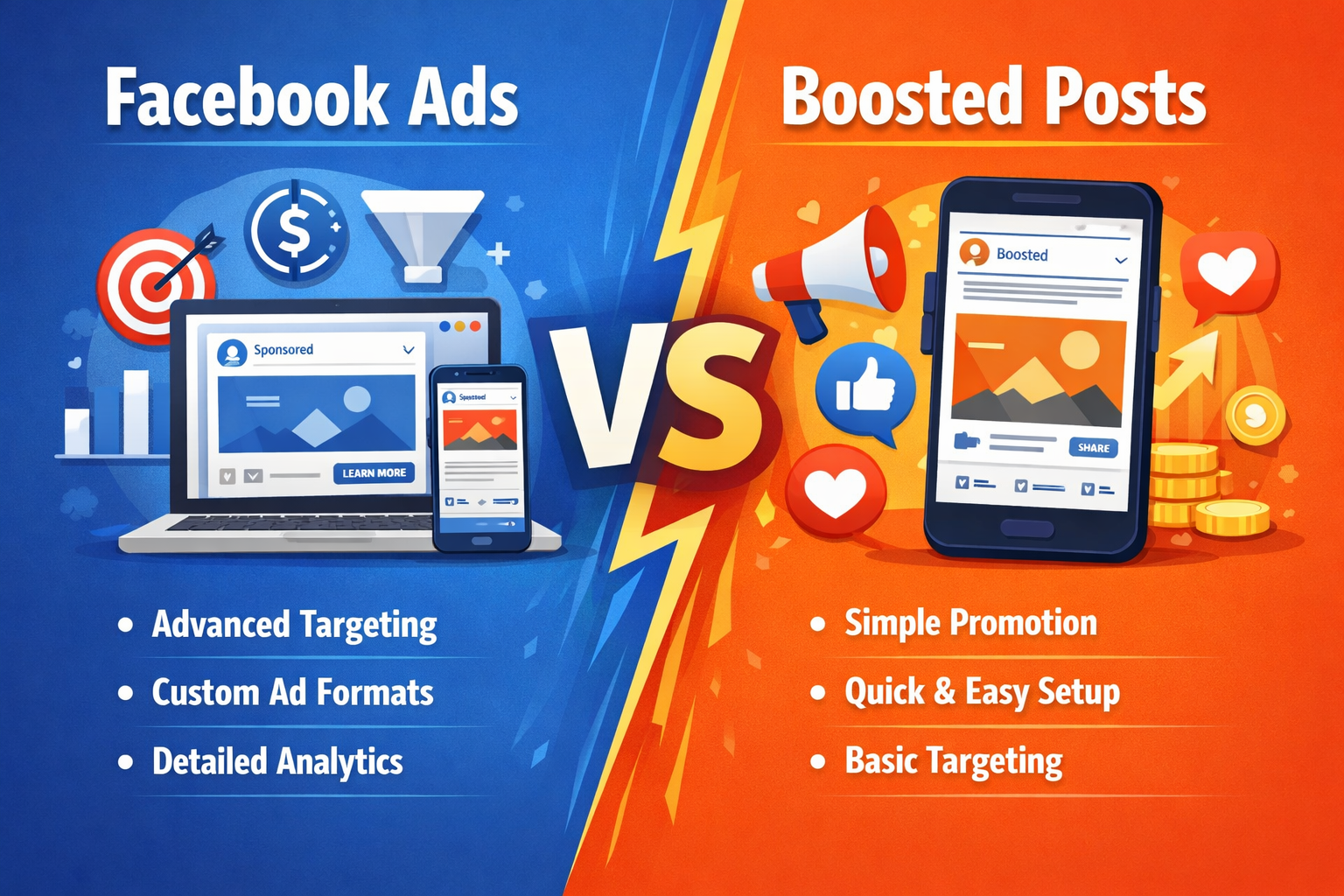
Digital marketing on social media has become essential for businesses of all sizes. Among all platforms, Facebook remains one of the most powerful channels for reaching targeted audiences. However, many marketers and business owners often get confused between Facebook Ads and Boosted Posts. At first glance, both look similar because they involve paid promotion. In reality, they serve different purposes and deliver different levels of control, performance, and return on investment. This article breaks down Facebook Ads vs Boosted Posts in detail, helping you decide which option fits your goals best.
Understanding the Core Difference Between Facebook Ads and Boosted Posts
The main difference between facebook marketplace Ads and Boosted Posts lies in strategy and control. Boosted posts are essentially existing posts on your Facebook page that you pay to show to more people. Facebook Ads, on the other hand, are created inside Ads Manager and are built specifically for advertising goals like conversions, leads, traffic, or sales.
Boosted posts are quick and simple. They are designed for page owners who want easy visibility without learning advanced ad tools. Facebook Ads are more complex but offer much deeper targeting, placement options, and optimization features. In short, boosted posts focus on visibility, while Facebook Ads focus on results.
What Are Boosted Posts and When Do They Work Best?
Boosted posts are ideal when your main objective is engagement. If you already have a post performing well organically and want to push it further, boosting can help you reach more people who might like, comment, or share. The setup is simple and can be done directly from your page within minutes.
This option works best for brand awareness, community updates, announcements, or social proof. For example, if you are promoting a new blog post, sharing a company milestone, or announcing a limited-time event, boosted posts can amplify reach quickly. However, they are not designed for complex marketing funnels or advanced sales tracking.
What Are Facebook Ads and Why Are They More Powerful?
Facebook Ads are created using Ads Manager and allow advertisers to choose very specific objectives such as website traffic, app installs, lead generation, or conversions. You can create custom creatives, run A/B tests, track pixel-based conversions, and scale campaigns strategically.
This level of control makes Facebook Ads far more powerful for businesses focused on growth and profitability. You can target users based on detailed demographics, behaviors, interests, retarget website visitors, and create lookalike audiences. Facebook Ads are best for long-term campaigns, performance marketing, and measurable ROI.
Targeting Options: Simplicity vs Precision
One of the biggest differences between Facebook Ads vs Boosted Posts is targeting. Boosted posts allow basic targeting such as age, gender, location, and interests. While this may be enough for small campaigns, it limits your ability to reach high-intent users.
Facebook Ads offer advanced targeting options. You can retarget people who visited your website, watched your videos, engaged with your Instagram content, or added products to their cart. You can also build lookalike audiences based on your best customers. This precision targeting leads to better conversions and lower costs over time.
Budget Control and Cost Efficiency
Boosted posts usually feel cheaper because they are easier to launch with small budgets. However, the cost per meaningful action is often higher. Since boosted posts focus mostly on engagement, you may get likes and comments that do not translate into sales or leads.
Facebook Ads allow better budget optimization. You can control daily or lifetime budgets, bid strategies, and campaign optimization. Over time, Facebook’s algorithm learns and delivers ads to people most likely to convert. This often results in better cost efficiency, especially for businesses focused on revenue rather than visibility.
Analytics, Tracking, and Optimization Capabilities
Boosted posts provide very limited analytics. You can see basic metrics like reach, likes, comments, and shares. However, deeper insights such as conversion tracking, funnel performance, or attribution are missing.
Facebook Ads provide robust reporting tools. You can track impressions, clicks, conversions, cost per result, return on ad spend, and more. This data allows continuous optimization. You can pause underperforming ads, scale winning creatives, and improve targeting. For serious marketers, this data-driven approach is essential.
Creative Flexibility and Placement Options
Boosted posts only promote existing page posts. You cannot fully customize the ad format or placements. Your boosted content may appear mostly in the Facebook feed, limiting exposure across the platform.
Facebook Ads offer creative flexibility. You can create image ads, video ads, carousel ads, collection ads, and story ads. You can also choose placements across Facebook, Instagram, Messenger, and Audience Network. This allows brands to meet users where they are most active and engaged.
Choosing the Right Option for Your Business Goals
If your goal is quick visibility, social engagement, or promoting an already successful post, boosted posts are a simple solution. They are easy to use and require minimal setup. Small businesses and beginners often start here.
If your goal is leads, sales, website traffic, or long-term growth, Facebook Ads are the better choice. They require more learning but deliver better results through advanced targeting, analytics, and optimization. Most successful businesses eventually move from boosted posts to structured ad campaigns.
Final Verdict: Facebook Ads vs Boosted Posts
Facebook Ads vs Boosted Posts is not about which one is better overall, but which one is better for your objective. Boosted posts are useful for awareness and engagement. Facebook Ads are designed for performance and scalability.
For businesses serious about digital marketing success, Facebook Ads provide far more value in the long run. Boosted posts can still play a supporting role, but they should not replace a well-planned advertising strategy. Understanding the strengths and limitations of both options allows you to invest your budget wisely and achieve consistent results.
