
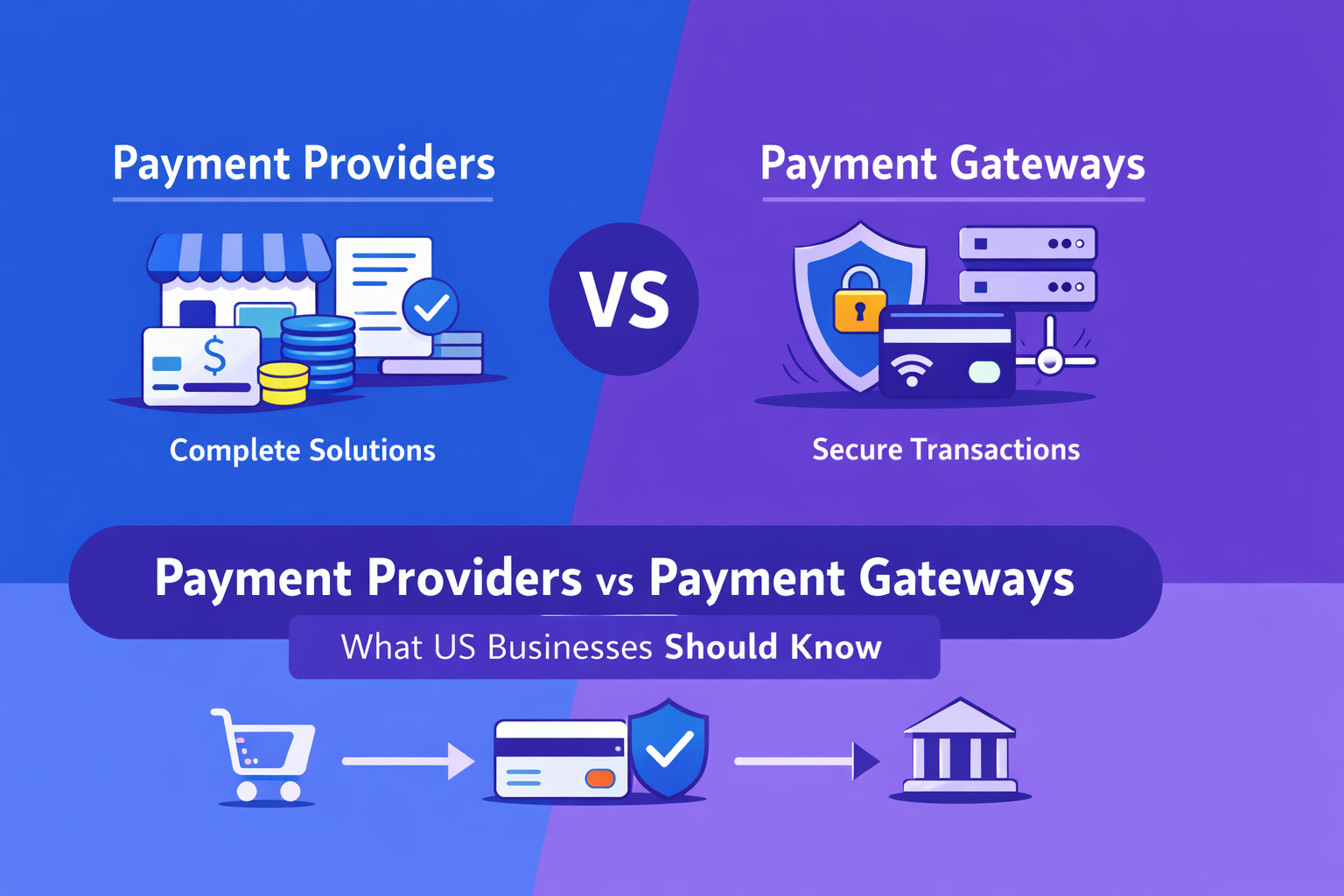
As digital payments continue to dominate commerce in the United States, businesses of all sizes are faced with one recurring challenge: choosing the right payment infrastructure. Terms like Payment Providers, Payment Gateways, payment processors, and merchant services are often used interchangeably, creating confusion for founders, finance leaders, and operations teams alike.
For startups and small businesses, this confusion can lead to poor decisions—choosing solutions that are either too complex, too expensive, or incapable of supporting future growth. For larger e-commerce brands, SaaS companies, and marketplaces, misunderstanding the difference between Payment Providers and Payment Gateways can result in scalability issues, compliance risks, and operational inefficiencies.
This guide breaks down Payment Providers vs Payment Gateways in clear, business-first terms. Whether you are a non-technical decision-maker or a fintech professional comparing infrastructure options, this article will help you understand how each solution works, how they differ, and how to choose the right approach for your business.
What Are Payment Providers?
Payment Providers are comprehensive payment solutions that enable businesses to accept, process, and manage digital transactions end to end. Rather than offering a single function, Payment Providers typically bundle multiple services into one integrated platform.
Core Functions of Payment Providers
Payment Providers generally handle:
- Payment acceptance (credit cards, debit cards, digital wallets, ACH, BNPL, etc.)
- Transaction processing and authorization
- Settlement and payouts to business bank accounts
- Fraud detection and risk management
- Compliance support (PCI DSS, KYC, AML)
- Reporting, reconciliation, and analytics
From a business perspective, Payment Providers act as a single point of contact for most payment-related needs. This is why they are often preferred by startups, SMBs, and fast-growing companies that want simplicity and speed.
Who Typically Uses Payment Providers?
In the US market, Payment Providers are commonly used by:
- Startups launching online products or services
- Small and medium-sized businesses seeking fast setup
- E-commerce stores needing multi-payment-method support
- SaaS companies with recurring billing needs
- Marketplaces and platforms managing multiple sellers
By abstracting away technical complexity, Payment Providers allow businesses to focus on growth rather than infrastructure.
What Are Payment Gateways?
A Payment Gateway is a more specialized component of the payment ecosystem. Its primary role is to securely transmit payment data from a customer to the payment processor and issuing bank.
What Payment Gateways Do
Payment Gateways:
- Encrypt and transmit payment details securely
- Facilitate authorization between banks and card networks
- Act as the “digital checkout bridge” during a transaction
- Support tokenization and secure data handling
What Payment Gateways Do Not Do
Unlike Payment Providers, Payment Gateways typically do not:
- Settle funds into merchant bank accounts
- Manage payouts or reconciliation
- Offer merchant accounts on their own
- Handle full compliance or fraud mitigation
This means a business using only a Payment Gateway will still need additional services—such as a payment processor or merchant account provider—to complete the payment flow.
Payment Providers vs Payment Gateways: Core Differences Explained
Understanding the distinction between Payment Providers and Payment Gateways is critical when evaluating payment infrastructure.
Scope of Services
- Payment Providers offer an all-in-one solution, covering acceptance, processing, settlement, and reporting.
- Payment Gateways focus narrowly on secure data transmission during checkout.
Operational Responsibility
- Payment Providers manage most compliance, risk, and operational overhead.
- Payment Gateways require businesses to manage additional vendors and integrations.
Integration Complexity
- Payment Providers are typically easier to integrate, with pre-built tools and APIs.
- Payment Gateways may require more technical expertise and coordination.
Ideal Business Fit
- Payment Providers suit businesses prioritizing speed, simplicity, and scalability.
- Payment Gateways suit businesses needing customization or already operating complex payment stacks.
How Payment Providers and Payment Gateways Work Together
Despite their differences, Payment Providers and Payment Gateways are not mutually exclusive. In many cases, they work together within the same transaction flow.
A Simplified Payment Flow
- Customer enters payment details at checkout
- Payment Gateway encrypts and transmits data
- Payment Provider processes the transaction
- Funds are authorized, captured, and settled
- Business receives payouts and reports
In bundled solutions, the Payment Provider includes a built-in Payment Gateway, eliminating the need for separate integrations.
When Bundled Payment Providers Make Sense
For most US startups and SMBs, bundled Payment Providers reduce:
- Setup time
- Vendor coordination
- Compliance burden
- Long-term maintenance costs
Cost & Pricing Models: What US Businesses Should Expect
Pricing is often a deciding factor when comparing Payment Providers and Payment Gateways—but it’s also one of the most misunderstood areas.
Payment Providers Pricing Models
Payment Providers commonly charge:
- Per-transaction fees (percentage + fixed fee)
- Cross-border or currency conversion fees
- Chargeback or dispute fees
- Optional add-on service fees
The benefit is predictability and fewer hidden costs.
Payment Gateways Pricing Models
Payment Gateways may charge:
- Monthly subscription fees
- Per-transaction gateway fees
- Setup or integration costs
Since they do not handle settlement, businesses must also pay separate processing and banking fees.
Cost vs Value
While Payment Providers may appear more expensive at first glance, they often reduce total cost of ownership by consolidating services.
Compliance, Security, and Risk Management
Compliance is non-negotiable in the US payments ecosystem, particularly for businesses handling sensitive customer data.
How Payment Providers Support Compliance
Payment Providers typically assist with:
- PCI DSS compliance
- Fraud monitoring and prevention
- KYC and AML checks
- Secure data storage and tokenization
This is especially valuable for non-technical teams and regulated industries.
Role of Payment Gateways in Security
Payment Gateways focus on:
- Data encryption
- Secure transmission
- Reducing exposure to sensitive data
However, responsibility for broader compliance often falls on the business.
Choosing Between Payment Providers and Payment Gateways
There is no universal “best” choice—only what fits your business needs.
When Payment Providers Are the Better Choice
- You want a fast, low-maintenance setup
- Your team lacks deep payments expertise
- You need built-in compliance and reporting
- You plan to scale quickly in the US market
When Payment Gateways May Be Appropriate
- You already have merchant accounts in place
- You need custom payment flows
- You operate at high transaction volumes
- You have in-house technical and compliance resources
How to Compare Payment Providers Effectively
With dozens of Payment Providers serving the US market, comparison is essential.
Key Evaluation Criteria
When comparing Payment Providers, consider:
- Supported payment methods
- Integration flexibility
- Pricing transparency
- Compliance coverage
- Customer support and reliability
- Scalability for future growth
Why Neutral Comparison Platforms Matter
Business listing platforms help bridge the gap between Payment Providers and service seekers by offering:
- Side-by-side comparisons
- Verified provider information
- Industry-specific filtering
- Transparent feature breakdowns
This reduces bias and accelerates decision-making.
Common Mistakes US Businesses Make
Even experienced businesses make avoidable mistakes when choosing payment infrastructure.
Frequent Pitfalls
- Choosing solely based on lowest fees
- Ignoring future scalability needs
- Overlooking compliance responsibilities
- Switching Payment Providers too late
- Underestimating integration complexity
Being proactive and informed helps avoid costly migrations later.
Final Thoughts: Making a Confident, Informed Decision
Understanding the difference between Payment Providers and Payment Gateways empowers US businesses to make smarter, growth-oriented decisions. While Payment Gateways play a critical technical role, Payment Providers offer a broader, business-friendly solution that simplifies operations, enhances security, and supports long-term scalability.
By evaluating your business model, technical capacity, and growth goals, you can determine which approach aligns best with your needs. Trusted comparison platforms and business listings further streamline this process by connecting businesses with the right Payment Providers—objectively, transparently, and efficiently.
In an increasingly competitive digital economy, choosing the right payment foundation is not just a technical decision—it’s a strategic one.
