
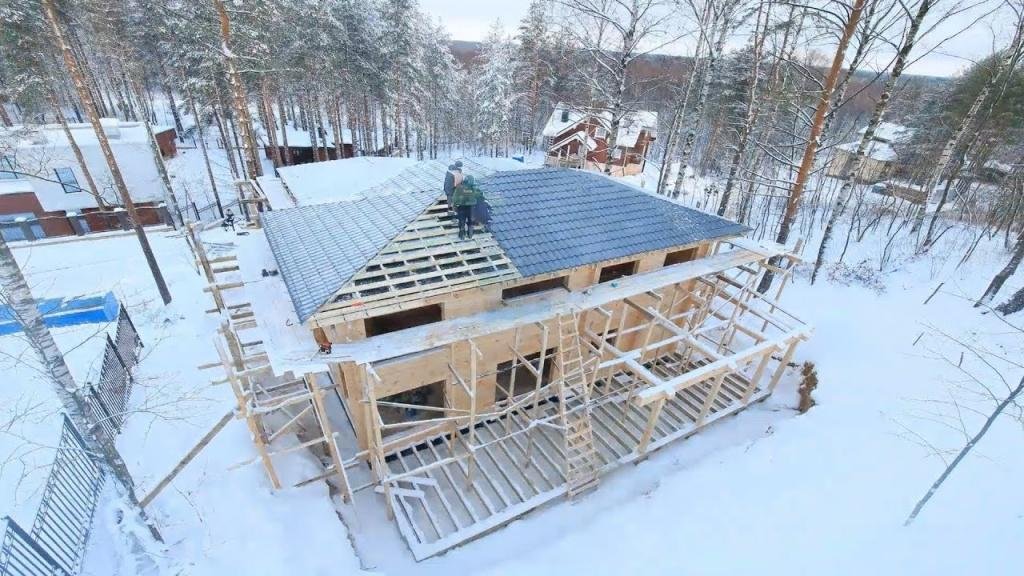
Installing a roof in winter allows the construction cycle to continue as cold weather approaches. Moreover, this approach allows for the construction of a protective structure over the walls, preventing snow and rain from penetrating. Once the roof is complete, the cottage owner can begin finishing work, ready to move in for the next summer season.
Roofing work in winter must be carried out taking into account the challenges posed by low temperatures and other external factors. It’s extremely difficult to tackle this task on your own. It’s recommended to seek assistance from companies that specialize in roofing services for private homes. They are familiar with the nuances of winter construction and will perform the work with a guarantee of quality.
Permissibility of construction in winter
The absence of wet construction processes allows for roof construction at low temperatures. There’s no need for heating to dehydrate the mortar. The main drawback is frost and wind, which can make working outdoors at relatively high altitudes uncomfortable for the workers.
From a technological standpoint, there are no temperature restrictions for roofing installation. Builders can install the following roofing elements:
- Rafter system;
- Vapor and waterproofing membranes;
- Insulation;
- Lathing and counter-lathing.
Difficulties arise when installing the roofing. In winter, you can install the following without any additional measures:
- Metal tiles;
- Profiled steel sheets;
- Slate;
- Ceramic tiles.
However, when using flexible shingles or roofing felt (for flat roofs), it’s necessary to wait until the air temperature is at least -5°C or higher. Otherwise, it will be impossible to fuse the sheets together and prevent leaks.
Experts strongly advise against installing bitumen pavements during cold weather. However, modern building materials contain additives that help them maintain their flexibility in winter. The pavement won’t crumble or break in freezing temperatures.
If necessary, you can install bituminous shingles. However, they should be stored in a warm room beforehand, and the roofing should be heated with a heat gun after installation.
This approach increases installation costs and increases the risk of fire. Winter installation of bitumen shingles should only be entrusted to an experienced professional who has performed similar work before.
Looking for an Affordable Roofing Contractor Near Me Broadway VA? Get quality roof repair, replacement, and installation services from trusted local experts. Free estimates available!
Advantages and disadvantages of construction work in winter
It’s recommended to build a roof in winter if the air temperature doesn’t drop below -15°C and there’s no strong wind. Light snowfall won’t be a problem. This will also provide the homeowner with several benefits:
- There will be no rain during which it will be impossible to carry out work.
- Reducing construction costs through affordable materials. Due to low demand in winter, most stores offer significant discounts.
- Reducing the cost of construction services. As with materials, due to the lack of work, companies and construction crews are offering discounts.
- Optimizing the construction process. Necessary work can be completed during cold weather, leaving warmer weather for operations that cannot be carried out in winter.
However, many limitations must be taken into account. First and foremost, the short daylight hours necessitate the use of supplemental lighting. Work will also have to be paused during heavy snowfalls and freezing temperatures. The installation of asphalt shingles is more complicated, although metal roofing will not have these limitations.
Features of the work
In general, roof construction in winter is no different from summer. It’s just necessary to consider a few nuances dictated by specific climatic conditions.
Let’s look at the basic operations:
Installation of rafters.
Wood doesn’t change its properties at low temperatures. In fact, it’s not susceptible to rot in winter and doesn’t need to be protected from moisture or sun. However, installation is best carried out at temperatures down to -20°C. Extreme cold increases the brittleness of boards and beams, which can cause cracks.
Installation of roofing cake
In this case, temperature is unimportant, but humidity does affect the quality of the work. Never install insulation or membranes during snowfall. Moisture getting between the layers can cause the insulation to become damp and lose its properties.
Laying roofing
Ceramic tiles and metal roofing materials are resistant to low temperatures. The only limitation may be strong winds, which can make installing large corrugated sheets difficult.
In most cases, winter construction work is caused by severe roof damage. If defects are discovered, major or routine repairs are carried out using the same techniques as in the summer. The only difference is the need to protect the roofing structure from precipitation.
Where to apply
If you need to build a roof for your home in winter, contact our construction company for help. Our experienced craftsmen will carry out the necessary work in strict compliance with the required standards. They guarantee quality work regardless of weather conditions.
