
This is one of the most searched questions about ghee in India right now, and it deserves a straight answer rather than the usual mix of enthusiasm and vague disclaimers.
Short answer: A2 ghee is not a weight loss supplement. But it can be part of a diet that supports healthy weight, and here’s why that’s not a contradiction.
The Fat-Burns-Fat Principle
Ghee is almost entirely fat — roughly 99.5% fat, the rest being trace moisture. For anyone who grew up with the message that fat causes weight gain, eating ghee to lose weight sounds backwards. But this thinking is about 40 years out of date.
The type of fat matters enormously. Ghee contains medium-chain triglycerides (MCTs), which the liver processes differently from long-chain fats. MCTs are converted to energy more readily and are less likely to be stored as body fat. They also have a mild thermogenic effect — meaning they slightly raise metabolic rate.
More practically: fat is satiating. A meal cooked in or served with A2 ghee is more filling than the same meal without it. When you’re full, you eat less at the next meal. The calorie math is not as simple as “fat = fat storage.”
CLA and Body Composition
Conjugated linoleic acid, found in meaningful amounts in ghee from grass-fed cows like Vashishti’s Gir cattle, has been studied specifically for its effect on body composition. The research suggests CLA may reduce body fat percentage while preserving lean muscle mass — a combination that straightforward caloric restriction often fails to achieve.
The CLA content in ghee from intensively-farmed cows is significantly lower than in ghee from grass-fed cows. This is one area where the sourcing of your ghee actually changes the nutritional outcome.
What Ghee Won’t Do
It will not overcome a diet of processed food and excess calories. There is no food that does that. If you’re eating 500 calories more than you need every day and adding ghee on top, the ghee will not compensate.
What it can do, within a sensible diet, is improve satiety, support metabolic function, and replace less healthy cooking fats. The trade is usually: stop cooking with refined seed oils, start cooking with ghee. That trade is almost always a health improvement.
The Vashishti Advantage Here
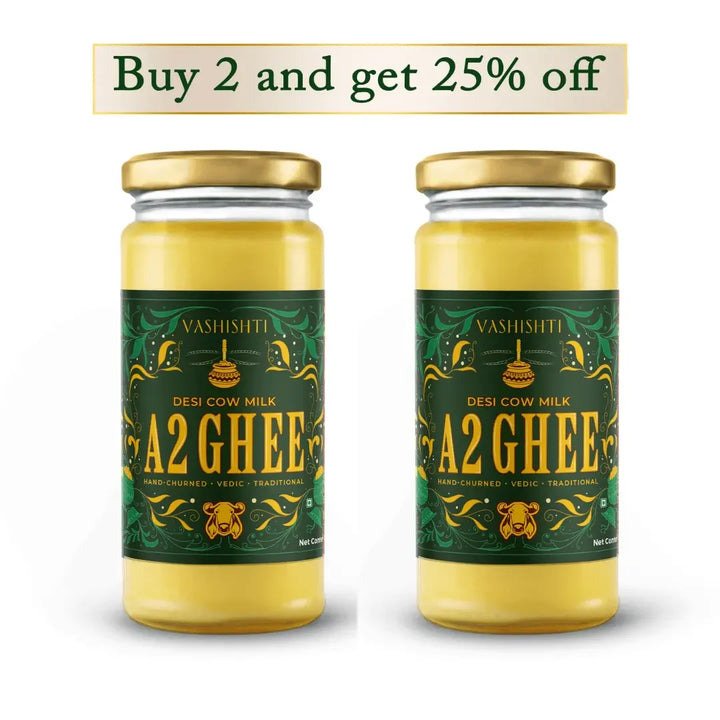
Vashishti A2 Ghee, made from grass-fed Gir cows via the bilona process, has a higher CLA content than commercially produced ghee. The slow clarification process preserves the fatty acid profile better than high-heat industrial methods. If you’re going to use ghee as part of a diet strategy, using ghee where the beneficial compounds are actually present makes more sense than using a cheaper alternative where they’ve largely been destroyed.
One to two teaspoons per day. In your cooking or on your food. Not more, not less. That’s the sensible dose.

Author
s83850156@gmail.com