
When a person experiences sudden cardiac arrest, every second matters. The brain can suffer permanent damage if it does not receive oxygen within four minutes. This short window is often called the critical survival period, the time when immediate action can mean the difference between life and death.
Emergency medical services in the United States provide rapid care, but response times commonly range from seven to twelve minutes after a 911 call is placed. During these vital minutes, the person standing nearby becomes the most important link in the chain of survival. A bystander who acts quickly can keep blood flowing to the brain until professional help arrives.
Many people hesitate because they fear doing something wrong. This fear prevents lifesaving action even when someone urgently needs help. To overcome this hesitation, the American Heart Association introduced Hands-Only CPR, a simplified technique that allows anyone to provide immediate assistance during cardiac arrest.
What Is Hands-Only CPR?
Hands-Only CPR is a form of cardiopulmonary resuscitation that focuses entirely on chest compressions without rescue breaths. Instead of combining compressions with mouth-to-mouth ventilation, rescuers deliver continuous, high-quality compressions to maintain circulation.
This approach is recommended for teenagers and adults who suddenly collapse outside a hospital. It is especially effective for untrained bystanders who may feel uncomfortable performing traditional CPR.
The goal is simple: keep oxygenated blood moving to the brain and vital organs until emergency responders arrive or an automated external defibrillator (AED) is available.
Why Mouth-to-Mouth Was Removed for Bystanders
Traditional CPR followed the “A-B-C” method—Airway, Breathing, and Circulation. Modern research revealed that immediate chest compressions are often the most critical action during sudden cardiac arrest.
1. Existing Oxygen Reserves
When circulation stops, oxygen remains stored in the bloodstream and lungs for several minutes. Continuous chest compressions help deliver this remaining oxygen to the brain and heart.
2. Maintaining Blood Pressure
Stopping compressions to provide breaths lowers blood pressure. Continuous compressions maintain blood flow and improve survival outcomes.
3. Increased Willingness to Help
Many people hesitate to perform mouth-to-mouth contact with strangers. Hands-Only CPR removes this barrier and increases the likelihood that bystanders will act quickly.
Step-by-Step Guide to Hands-Only CPR
If you witness an adult suddenly collapse, act immediately.
Verify Scene Safety and Responsiveness
• Ensure the area is safe.
• Tap the person’s shoulders firmly.
• Ask loudly, “Are you okay?”
• Check for normal breathing.
If the person is not breathing normally or is gasping, begin CPR immediately.
Activate Emergency Response
• Call 911 immediately.
• Use speakerphone so dispatchers can guide you.
• If others are present, point to a specific person and instruct them to call 911 and locate an AED.
Clear instructions prevent confusion and save valuable time.
Position the Person for Compressions
• Lay the person flat on their back.
• Use a firm surface such as the floor.
• Avoid beds or sofas that absorb pressure.
• Kneel beside the chest.
The “Hard and Fast” Compression Rule
Hand Placement
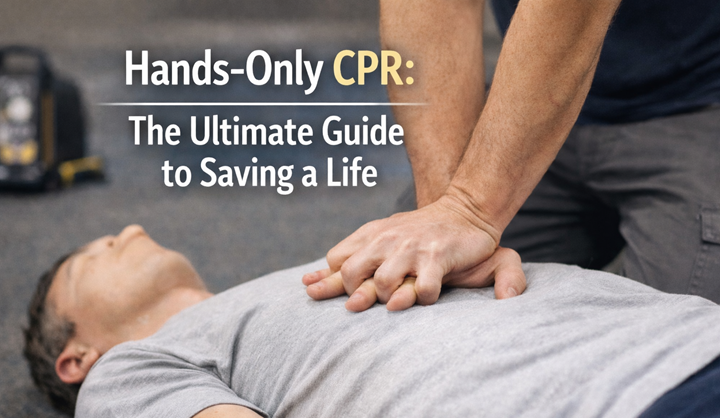
• Place the heel of one hand in the center of the chest.
• Place the second hand on top.
• Interlock fingers and keep arms straight.
Compression Depth
• Push at least 2 inches deep.
• Allow the chest to fully recoil between compressions.
Compression Rate
• Maintain 100–120 compressions per minute.
Full recoil allows the heart to refill with blood before the next compression.
The Role of an AED
CPR keeps blood circulating, but an Automated External Defibrillator can restore a normal heart rhythm.
AEDs are commonly found in airports, offices, schools, gyms, and public spaces.
• Turn the AED on immediately.
• Follow voice instructions.
• Attach pads as shown on the device.
• Clear the patient when instructed before delivering a shock.
• Resume CPR immediately afterward.
AEDs are designed for public use and guide rescuers step by step.
Hands-Only CPR vs. Conventional CPR
Hands-Only CPR works best for sudden adult cardiac arrest. Traditional CPR with rescue breaths remains important in specific situations:
• Infants and children — cardiac arrest often begins with breathing problems.
• Drowning victims — oxygen deprivation is the primary issue.
• Drug overdoses — breathing failure commonly causes collapse.
In these cases, rescue breaths provide essential oxygen support.
Professional Training: The Gold Standard
Hands-Only CPR empowers the public to respond quickly, but professional training offers deeper lifesaving knowledge. Healthcare workers, teachers, childcare providers, and workplace safety personnel benefit from structured instruction covering choking emergencies, team response, and pediatric care.
Specialized certification programs build confidence, improve response time, and prepare individuals for high-stakes emergencies:
- Basic Life Support (BLS) certification: The foundational course for healthcare providers and public safety professionals, focusing on high-quality CPR and team dynamics.
- Advanced Cardiovascular Life Support (ACLS): An advanced tier for medical professionals that covers urgent treatment for cardiac arrest, stroke, and other life-threatening cardiovascular emergencies through clinical algorithms and medication management.
- Pediatric Advanced Life Support (PALS): A specialized program designed for healthcare providers who respond to emergencies in infants and children, emphasizing a systematic approach to pediatric assessment and advanced resuscitation.
Overcoming the Fear of Helping
Fear is one of the biggest barriers preventing people from performing CPR. Understanding legal and medical realities helps reduce hesitation.
Good Samaritan Protection
Good Samaritan laws protect individuals who provide reasonable emergency assistance in good faith. These laws encourage bystanders to help without fear of legal consequences.
Risk of Injury vs. Saving a Life
Chest compressions may occasionally cause rib fractures, but broken ribs heal. Brain damage from lack of oxygen does not. Immediate CPR gives a cardiac arrest victim their best chance of survival.
Why Learning Hands-Only CPR Matters
Most sudden cardiac arrests occur at home, often witnessed by family members or friends. The person needing help is rarely a stranger, it is usually someone you love.
Learning Hands-Only CPR transforms a bystander into a lifesaver. With only your hands and the confidence to act, you can maintain blood flow, protect brain function, and buy precious time until emergency professionals arrive.
Quick action saves lives. The next emergency could happen anywhere, and the person who makes the difference could be you.
Summary
Hands-Only CPR enables anyone to respond immediately during sudden cardiac arrest using continuous chest compressions. Learning this simple technique increases survival chances and empowers bystanders to act confidently before emergency services arrive.
