
Introduction
Land is one of the most valuable assets in India, yet many landowners struggle to convert it into usable capital. Traditionally, when funds are needed, landowners resort to selling their land—often under pressure or unfavorable conditions. This leads to forced land sales, where assets are liquidated below their true value.
However, modern financial strategies have introduced a smarter alternative: land monetisation. Instead of selling land outright, owners can unlock its value and generate capital while retaining ownership.
This blog explores the key differences between land monetisation vs forced land sales, helping you understand which approach is better for sustainable capital raising.
What is Land Monetisation?
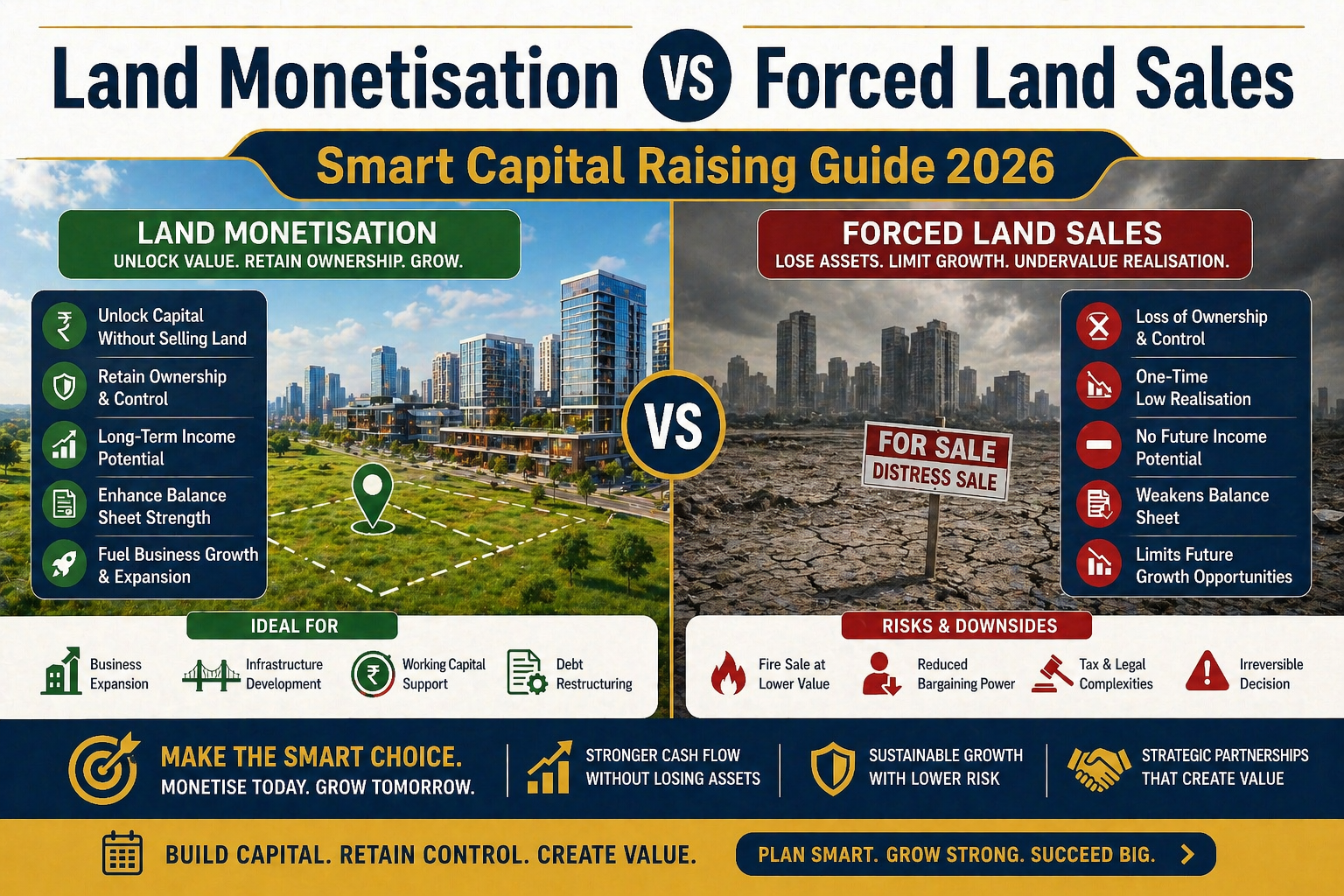
Land monetisation is the process of converting the value of land into financial capital without selling ownership. It involves structured strategies such as leasing, joint ventures, development rights, or asset-backed financing.
According to financial and infrastructure insights, land monetisation typically includes leasing or granting development rights to generate funds while retaining ownership.
It allows landowners to:
- Generate recurring income
- Raise funds for business expansion
- Retain long-term asset ownership
- Unlock idle or underutilised land value
In simple terms, land monetisation turns land into a financial asset rather than a static investment.
What are Forced Land Sales?
Forced land sales occur when a landowner sells property due to financial pressure, debt, legal issues, or urgent liquidity needs. These sales are often:
- Time-bound
- Negotiated under stress
- Priced below market value
In such situations, buyers gain leverage, and sellers lose bargaining power. The result is loss of wealth and future appreciation potential.
Key Differences: Land Monetisation vs Forced Land Sales
| Factor | Land Monetisation | Forced Land Sales |
|---|---|---|
| Ownership | Retained | Lost permanently |
| Capital Generation | Structured & strategic | Immediate but often undervalued |
| Income Potential | Recurring income streams | One-time payment |
| Risk Level | Lower (if structured well) | High financial loss risk |
| Long-Term Value | Preserved & grows | Completely forfeited |
| Flexibility | High | None |
Why Forced Land Sales Are Risky
1. Undervaluation of Assets
When land is sold under pressure, it rarely fetches its true market value. Buyers often exploit urgency.
2. Loss of Future Appreciation
Land prices in India have consistently appreciated, especially in urban and semi-urban areas. Selling today means losing tomorrow’s growth.
3. No Recurring Income
Once sold, the asset no longer generates income, eliminating long-term financial stability.
4. Emotional and Legacy Loss
For many families, land is not just an asset but a legacy. Forced sales can result in irreversible loss.
Why Land Monetisation is a Smarter Strategy
1. Unlocks Hidden Value
Many land parcels remain idle. Monetisation converts them into income-generating assets.
2. Retains Ownership
Unlike selling, monetisation ensures that ownership stays with the landowner while still generating capital.
3. Supports Business Growth
Funds generated can be used for:
- Business expansion
- Debt restructuring
- New investments
4. Reduces Debt Dependency
Instead of high-interest loans, land monetisation offers asset-backed funding, reducing financial burden.
5. Creates Long-Term Wealth
By retaining land ownership, owners benefit from both:
- Income generation
- Capital appreciation
Popular Land Monetisation Models
1. Lease-Based Monetisation
Land is leased to developers or companies for a fixed period, generating steady rental income.
2. Joint Development Agreements (JDA)
Landowners partner with developers to build residential or commercial projects and share profits.
3. Revenue Sharing Models
Income generated from land usage is shared between the landowner and investor.
4. Asset-Backed Financing
Land is used as collateral to raise funds without selling it.
5. Development Rights Transfer
Owners sell development rights instead of the land itself.
These models ensure that landowners can raise capital while maintaining control over their assets.
Land Monetisation in India: A Growing Trend
Land monetisation is gaining momentum across India as a structured funding solution. Governments and private entities are increasingly using land assets to generate capital for infrastructure and development projects.
This shift reflects a broader trend toward asset-backed financing, where land value is leveraged instead of relying solely on debt.
When Should You Choose Land Monetisation?
Land monetisation is ideal when:
- You need capital but don’t want to sell land
- Your land is idle or underutilised
- You want recurring income
- You are planning long-term wealth creation
When Forced Sale May Be Unavoidable
While monetisation is preferable, forced sales may occur in situations like:
- Severe financial distress
- Legal disputes
- Urgent liquidity requirements
However, even in such cases, exploring structured monetisation options first is advisable.
Real-Life Example
Imagine a landowner with a 2-acre plot near a developing highway:
Scenario 1: Forced Sale
- Immediate sale at ₹2 crore
- No future gains
- Loss of ownership
Scenario 2: Land Monetisation
- Lease to a logistics company
- Annual income of ₹20 lakh
- Retains ownership
- Land value increases over time
Over 10 years, monetisation not only generates ₹2 crore but also retains the asset.
Challenges in Land Monetisation
While beneficial, monetisation comes with challenges:
- Legal complexities
- Finding the right partners
- Structuring agreements
- Market risk
This is why professional advisory services play a crucial role.
How to Monetise Land Effectively
1. Land Assessment
Evaluate location, zoning, and development potential.
2. Legal Due Diligence
Ensure clear title, approvals, and compliance.
3. Choose the Right Model
Select leasing, joint venture, or financing based on goals.
4. Partner with Experts
Work with advisors who understand land valuation and structuring.
5. Plan Long-Term
Focus on sustainable income rather than quick gains.
Role of Advisory Platforms
Modern platforms and advisory services help landowners:
- Identify monetisation opportunities
- Structure deals
- Connect with investors
- Ensure legal compliance
This makes the process safer and more profitable.
SEO Insight: Why This Topic Matters
Search trends show increasing interest in:
- “How to raise funds from land”
- “Land monetisation India”
- “Alternatives to selling land”
This reflects a shift from traditional selling to strategic asset utilisation.
Conclusion
The choice between land monetisation vs forced land sales is essentially a choice between long-term wealth creation and short-term liquidity.
Forced land sales may provide immediate relief, but they often come at the cost of undervaluation and permanent asset loss. On the other hand, land monetisation offers a smarter, more sustainable approach—allowing landowners to unlock capital while retaining ownership and future growth potential.
In today’s evolving financial landscape, land should not just be seen as property—it should be treated as capital.
FAQs
1. Is land monetisation better than selling land?
Yes, in most cases, it allows you to generate income while retaining ownership.
2. Can I monetise agricultural land?
Yes, depending on zoning laws and permissible usage.
3. Is land monetisation safe?
It is safe if structured properly with legal and financial due diligence.
4. How long does monetisation take?
It depends on the model, but structured deals may take a few weeks to months.
