
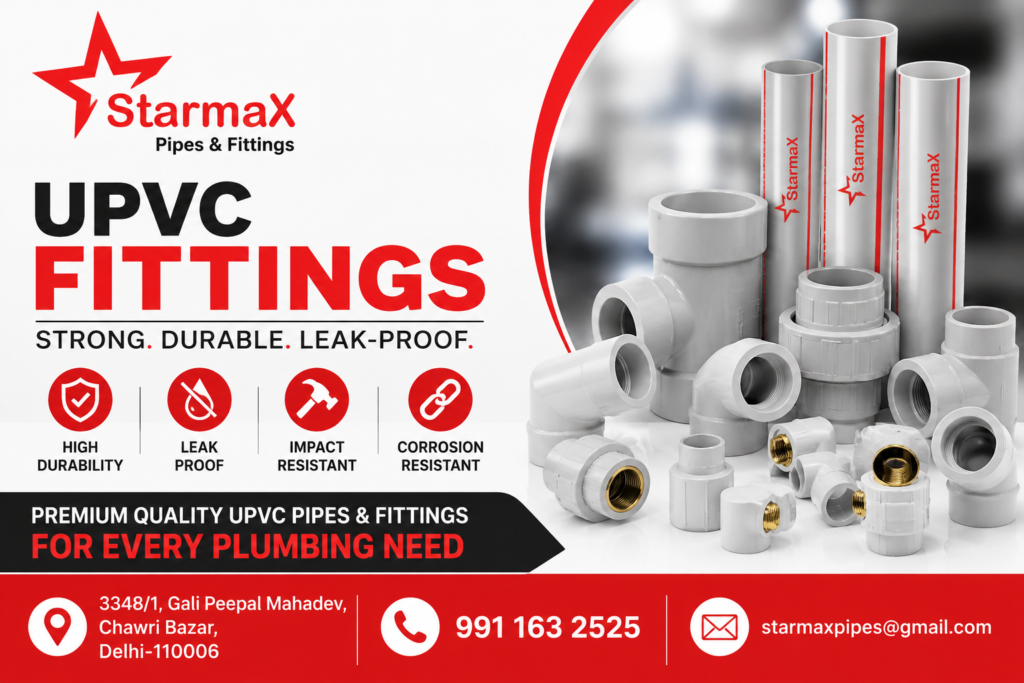
Plumbing infrastructure is only as reliable as the fittings holding it together. Pipes get most of the attention, but experienced contractors and engineers know that poorly chosen fittings are where most leaks, failures, and long-term maintenance headaches begin. Starmax addresses this gap with a comprehensive range of uPVC fittings engineered for durability, precision fit, and consistent performance across residential, commercial, and industrial water supply applications.
From elbows and tees to reducers and couplings, every Starmax fitting is manufactured to exacting dimensional standards — because in plumbing, even a fraction of a millimetre matters.
Why uPVC Remains the Material of Choice for Modern Plumbing
Not all plastic fittings are equal. Unplasticised polyvinyl chloride — uPVC — occupies a distinct position among plumbing materials because it combines rigid structural strength with excellent chemical resistance, all without the corrosion vulnerabilities that plague metal alternatives.
uPVC fittings do not rust, scale, or react with standard water supply chemicals. They handle a broad pH range and maintain dimensional integrity over decades of pressurised service. For builders and plumbers specifying materials on projects where long-term reliability matters, the material’s track record speaks clearly.
Starmax uPVC fittings carry ISO-compliant formulations and are manufactured lead-free — an important consideration for potable water systems where material safety is non-negotiable.
The Starmax uPVC Fittings Range
Starmax offers over 300 individual uPVC product SKUs, covering the full spectrum of fittings required in a properly designed water supply network. The range spans multiple size categories and pressure ratings, giving specifiers the flexibility to source everything from a single, consistent manufacturer.
Key fitting categories include:
- Elbows (45° and 90°) — for directional changes without flow restriction
- Equal and reducing tees — for branch connections in distribution networks
- Couplings and unions — for straight-line joins and maintenance access points
- End caps and plugs — for system termination and pressure testing
- Reducers and bushings — for diameter transitions within the same pipeline
- Flanges and adaptors — for integration with metal pipework or equipment inlets
Each fitting type is available across the standard size range to match Starmax uPVC pipe dimensions, ensuring compatibility and eliminating the guesswork that comes with mixing brands.
Material and Manufacturing Standards That Matter
Starmax fittings are produced from UV-stabilised, lead-free uPVC compound, making them suitable for both exposed outdoor installations and concealed indoor plumbing. UV stabilisation is particularly relevant in applications where fittings are installed above ground or in partially exposed service ducts — a detail often overlooked until premature material degradation becomes a costly problem.
The manufacturing process involves precise injection moulding under controlled conditions, resulting in fittings with consistent wall thickness, accurate thread profiles where applicable, and smooth internal bores that support good hydraulic flow.
Every batch is subject to quality checks covering dimensional accuracy, pressure rating, and solvent cement bond performance — the three variables that determine how a fitting performs under real operating conditions.
Selecting the Right uPVC Fittings for Your Project
Choosing fittings is not simply a matter of matching sizes. Several practical factors influence the correct specification:
Pressure rating — Residential cold water supply and high-rise distribution have different pressure demands. Confirm the Class 4 or Class 6 rating requirement for your system before ordering.
Solvent cement compatibility — Starmax uPVC fittings are designed for use with Starmax uPVC solvent cement. Using mismatched cements from different manufacturers can compromise joint strength and create long-term leak risk.
Temperature range — uPVC is rated for cold and ambient temperature water supply. For hot water lines above 60°C, CPVC is the appropriate alternative. Mixing materials in a hot water application is a common and avoidable error.
Application environment — Buried, exposed, or concealed installations each have different requirements for UV resistance, mechanical protection, and accessibility for future maintenance.
Getting these decisions right at the specification stage costs nothing. Getting them wrong after installation can be expensive.
Frequently Asked Questions
Q1. What are uPVC fittings used for in plumbing systems?
uPVC fittings are used to connect, redirect, branch, or terminate runs of uPVC pipework in cold water supply, drainage, and irrigation systems. They form the joints that allow a network of pipes to follow the layout of a building or infrastructure project while maintaining leak-free, pressurised flow.
Q2. Are Starmax uPVC fittings safe for drinking water supply lines?
Yes. Starmax uPVC fittings are manufactured using a lead-free compound, making them suitable for potable water applications. The material does not leach harmful substances into the water supply under normal operating conditions.
Q3. How do I join uPVC fittings to uPVC pipes?
The standard method is solvent cement welding. A compatible uPVC solvent cement is applied to both the pipe end and the fitting socket. When the two are pushed together, the cement chemically fuses the surfaces, creating a joint that is typically stronger than the pipe wall itself when cured correctly.
Q4. What sizes are available in the Starmax uPVC fittings range?
Starmax offers uPVC fittings across a broad size range to accommodate residential and commercial plumbing requirements. Available sizes follow standard IS and ISO pipe dimensions. For a detailed size chart and pressure ratings, refer to the official Starmax product catalogue or contact the sales team directly.
Q5. Can uPVC fittings be used for hot water supply systems?
Standard uPVC fittings are rated for cold and ambient temperature water — generally up to around 45°C. For hot water supply systems operating at higher temperatures, CPVC (chlorinated polyvinyl chloride) fittings are the correct specification. Starmax manufactures both product lines, so selecting the right material for the application is straightforward.
Conclusion
Reliable plumbing comes down to the quality of decisions made long before a tap is turned on. Material selection, fitting type, pressure rating, joint method — these details determine whether a system performs quietly for decades or requires attention within years. Starmax uPVC fittings are built for the former outcome: manufactured to consistent standards, available across a complete size range, and backed by an ISO-certified production process.
For contractors, builders, and specifiers who understand that every joint in a system carries responsibility, the Starmax range offers a straightforward answer — purpose-built fittings that do their job without compromise.
