
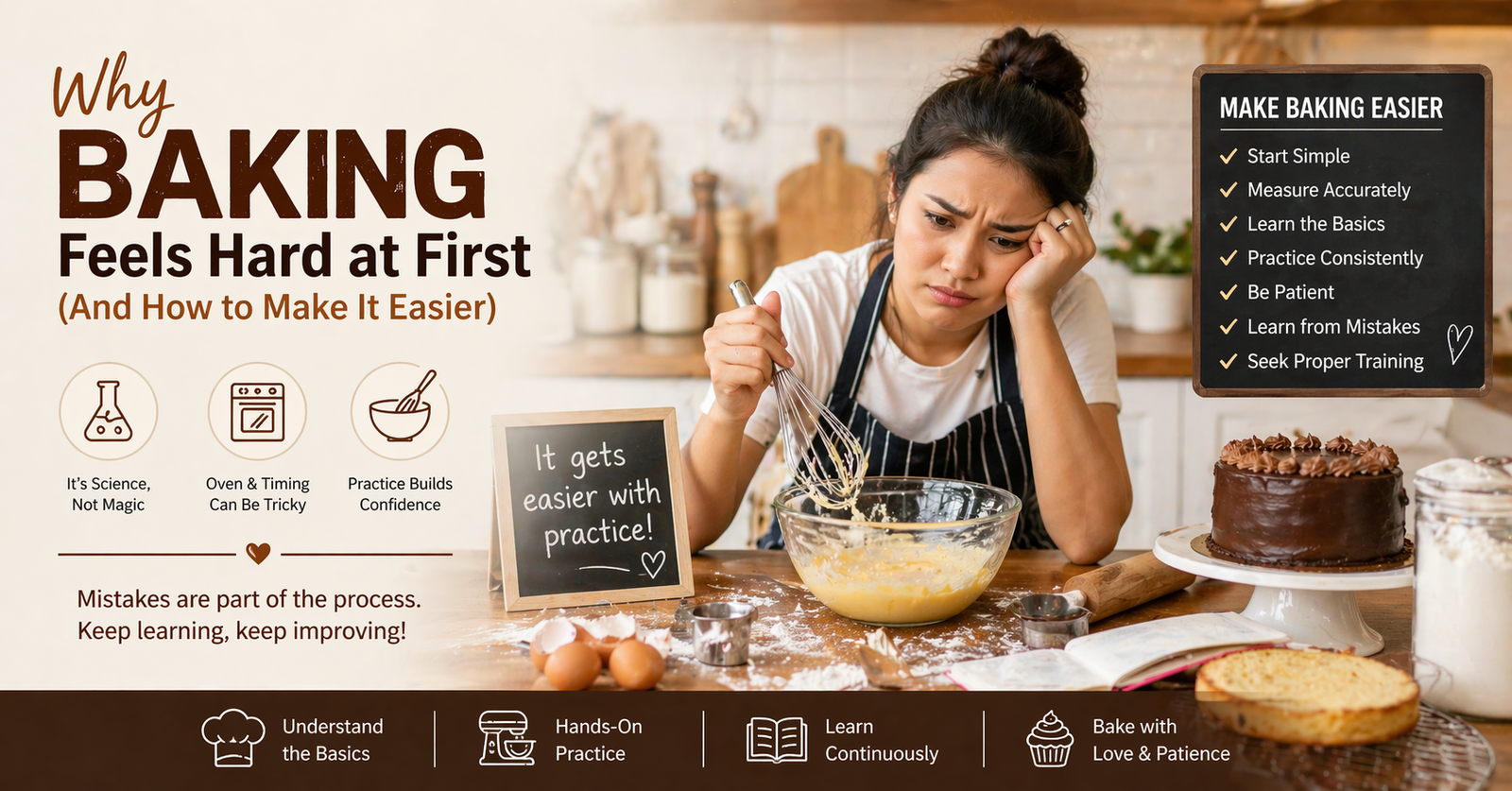
Baking has a quiet reputation for being precise, structured, and sometimes even unforgiving. For beginners, it often feels more difficult than expected. You follow a recipe carefully, measure ingredients with attention, and still end up with a cake that is too dense, cookies that spread too much, or bread that simply doesn’t rise. It can feel confusing and discouraging.
But here’s the truth: baking feels hard at first because it is a skill built on both science and practice. Once you understand the reasons behind the challenges, it becomes much easier to improve and enjoy the process.
The Science Behind Baking
Unlike cooking, baking relies heavily on accuracy and chemical reactions. Every ingredient has a role:
- Flour builds structure
- Eggs provide stability and moisture
- Sugar affects texture and browning
- Leavening agents control rise
Even a small mistake—like adding extra flour or incorrect oven temperature—can change the final result. This level of precision is often what makes baking feel difficult in the beginning.
In structured environments like Baking Classes in Chennai, beginners are introduced to this science step by step. Instead of just following recipes, they learn why each ingredient matters, which makes the process more predictable and less stressful.
Lack of Hands-On Experience
One of the biggest reasons baking feels hard is limited practical experience. Watching videos or reading recipes gives you an idea, but it doesn’t teach you how batter should feel, how dough should look, or when a cake is perfectly baked.
These are things you learn only by doing.
This is why Baking Courses in Chennai focus heavily on hands-on training. Repeated practice helps you:
- Understand textures
- Improve timing
- Build confidence
Over time, what once felt complicated becomes second nature.
Fear of Making Mistakes
Many beginners hesitate because they are afraid of doing something wrong. This fear leads to overthinking, hesitation, and sometimes even avoiding baking altogether.
But mistakes are not failures—they are learning signals.
A cake that sinks might be telling you:
- The oven door was opened too early
- The batter was overmixed
Cookies that spread too much might indicate:
- Too much butter
- Not enough chilling time
When you start seeing mistakes as feedback instead of failure, baking becomes easier and more enjoyable.
Difficulty Understanding Oven Behavior
Your oven plays a huge role in baking success, but most beginners don’t realize that oven temperatures are not always accurate. You might set 180°C, but the actual temperature could be higher or lower.
This leads to:
- Overbaked or underbaked results
- Uneven textures
- Inconsistent outcomes
Learning how your oven behaves—using tools like an oven thermometer—can make a big difference. With experience, you start adjusting temperatures and timings naturally.
Overcomplicating the Process
Another common reason baking feels difficult is trying to do too much too soon. Beginners often jump into complex recipes like layered cakes or advanced pastries without mastering the basics.
Starting simple is the key.
Focus on:
- Basic sponge cakes
- Simple cookies
- Easy breads
For those attending Cake Baking Classes in Anna Nagar, this step-by-step approach helps build a strong foundation before moving on to advanced techniques.
How to Make Baking Easier
Now that we understand why baking feels hard, let’s look at how to simplify the learning process.
1. Start with Simple Recipes
Choose beginner-friendly recipes and repeat them. Repetition builds confidence and helps you understand patterns in baking.
2. Measure Accurately
Use proper measuring tools instead of estimating. Baking is precise, and small differences can affect results significantly.
3. Learn the Basics First
Understand:
- Ingredient functions
- Mixing methods
- Baking temperatures
This knowledge reduces guesswork and improves consistency.
4. Practice Consistently
The more you bake, the more comfortable you become. Skills like identifying batter consistency or judging doneness improve only with repetition.
5. Don’t Rush the Process
Give yourself time to learn. Baking is not something you master overnight. Patience plays a big role in progress.
6. Learn in a Structured Environment
Guidance from professionals can speed up your learning. In Baking Classes in Chennai, students get real-time feedback, which helps correct mistakes immediately and avoid repeating them.
7. Understand Instead of Memorizing
Instead of memorizing recipes, focus on understanding techniques. This allows you to adapt and experiment with confidence.
Building Confidence Over Time
Confidence in baking doesn’t come from one perfect cake. It comes from:
- Trying repeatedly
- Learning from mistakes
- Understanding your tools and ingredients
As you continue practicing, you will notice:
- Better consistency
- Improved texture and taste
- Less confusion and more control
This transformation is gradual but powerful.
The Role of Proper Training
While self-learning is possible, structured learning can make the journey smoother. Baking Courses in Chennai are designed to guide students through:
- Basic to advanced techniques
- Real-time problem-solving
- Industry-level practices
This kind of training reduces the trial-and-error phase and builds confidence faster.
Conclusion
Baking feels hard at first because it combines precision, science, and skill—all of which take time to develop. But once you understand the fundamentals and gain hands-on experience, it becomes not only easier but also deeply enjoyable.
The key is to start simple, practice consistently, and learn from every mistake. With the right approach and guidance, baking transforms from something confusing into something creative and rewarding.
